

Plus: Register for our February 24th Zoom Discussion of Everything for Everyone
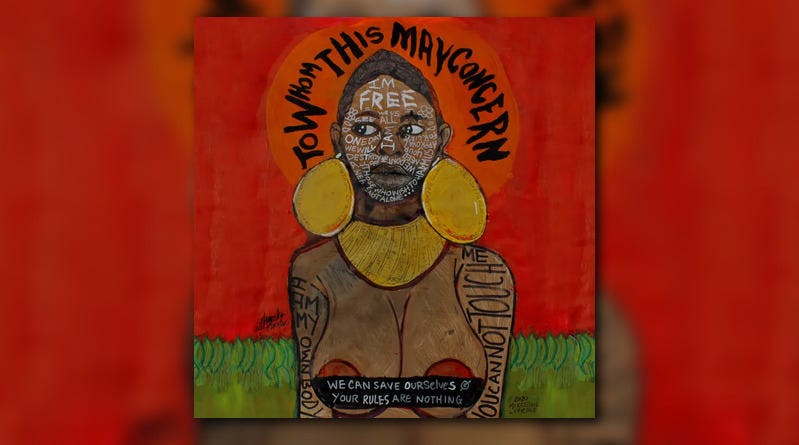
I have played Jill Scott’s new album To Whom This May Concern daily (multiple times per day, really) from top to bottom since she released it earlier this month. On my first listen, it immediately felt like a special project. I’m a longtime Jill Scott fan, and more broadly, a longtime Rhythm and Blues (R&B) fan with a particular admiration for the sound that emerged in the late ’90s and early 2000s, what many call neo-soul. Genre labels can be tricky. Some of the era’s pioneers resisted the term. D’Angelo, for example, pushed back against being labeled a neo-soul artist, insisting he simply made Black music. But that tension is part of the point. The music of that period was distinctly rooted in Blackness. “Neo-soul” may be imperfect, but it evokes a recognizable sound and texture. For lack of a better term, I’ll use it here.
I’m an early ’90s baby, and growing up, the sounds of neo-soul surrounded me. I remember being at my uncle’s house in Silver Spring, Maryland, pressing play on his CD player and hearing Erykah Badu’s album Baduizm fill the room. I loved the heavy bass of “Other Side of the Game.” My memories of getting my hair done on Saturday mornings are inseparable from songs like Jill Scott’s “The Way,” Bilal’s “Soul Sista,” and D’Angelo’s (a fellow Richmond, Virginia native, I might add) “Untitled (How Does It Feel).”
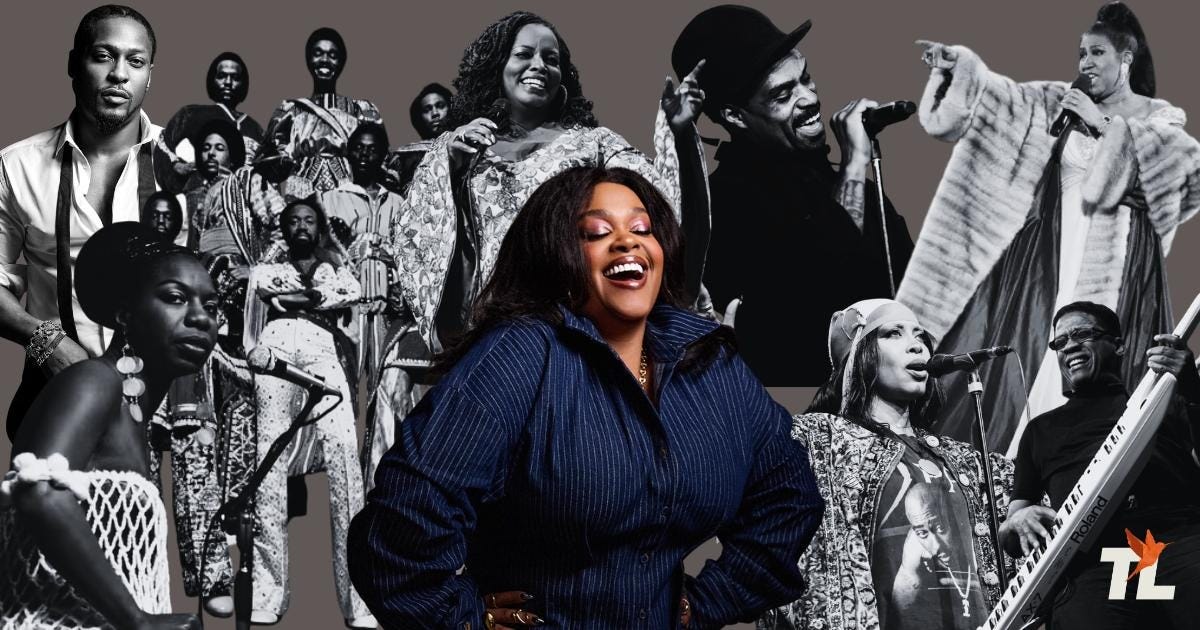
I am grateful to have grown up in a household and family that adored and appreciated music. It is something I carry with me deeply into adulthood. My grandmother played piano and insisted on me taking piano lessons as a child. I woke up to Nina Simone playing on Saturday mornings. My mom and I would belt the lyrics of Aretha Franklin’s “A Rose Is Still a Rose” on the way to school so much so that she affectionately called me Rosebud. And my dad, who plays jazz guitar, was constantly playing jazz and funk classics in the house like Dianne Reeves, Earth, Wind & Fire, and Herbie Hancock. While I appreciate those artists, even more now than I did as a child, neo-soul felt like the music that elders played around me that I also actually chose for myself. One of my first concerts was an Erykah Badu concert. She performed outdoors during a summer series in Richmond, and I begged my mom to take us. The tickets were a splurge – not in her budget, but it felt worth it to both of us. And wow, was it.
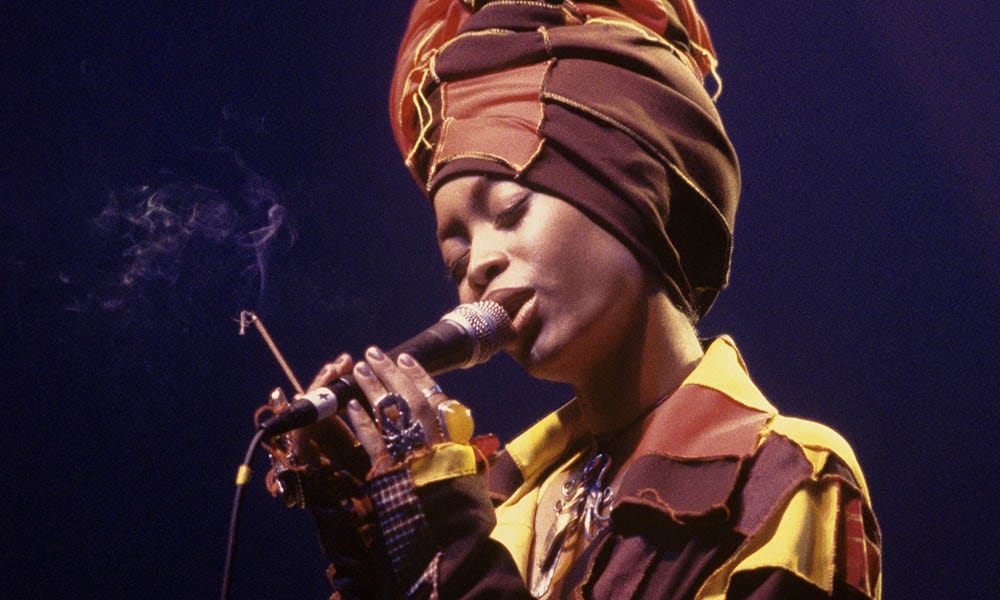
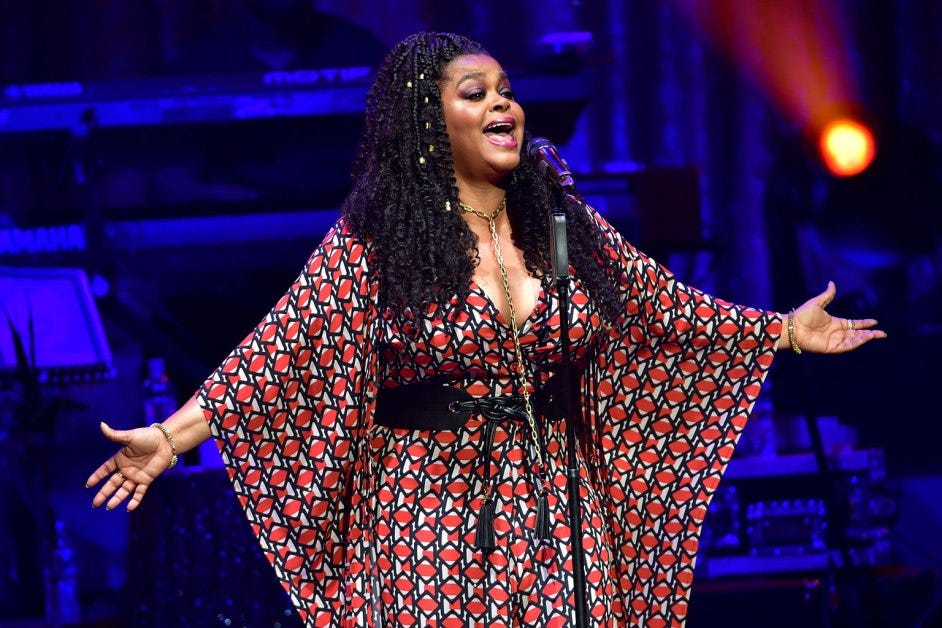
Looking back, I think as a young Black girl I was drawn to the sounds of neo-soul because they expressed a profound love for Black people: Black women, Black men, and Black culture. Artists like Jill Scott and Erykah Badu wore natural hair and head wraps, embraced Afrocentric themes, loved on Black people in their music videos, and sang of hardship and love in the context of Black culture. Their music felt removed from the desire to go mainstream or appeal to broader audiences. It was music meant to breathe life into Black people by reflecting ourselves back to us, regardless of respectability, all in the context of a world that tells us to be ashamed of Blackness. I attended mostly white schools growing up, and as a dark-skinned Black girl, I was constantly being told, expressly and subliminally, to be ashamed of who I was. These artists provided a foil to those experiences. They were beautiful and proud, and deep down I knew I should be, and was, too.
Returning to Jill Scott’s latest project, To Whom This May Concern. The album dropped on February 13, 2026, and when I first saw the release date, I was expecting more of what I love from Jill Scott — her beautiful songs about love. And she did generously give us that. But what also became immediately clear to me is that Jill dropped this album very intentionally on the 13th, the day before many of us celebrate love and during Black History Month. This album is a love letter to Blackness and to Black people. While the album is solidly an R&B project, Jill honors the breadth of contributions Black Americans have made to music and the variety of Black musical traditions that exist throughout her 19 songs.
She travels to New Orleans and celebrates brass bands on “Be Great,” which features New Orleans legend Trombone Shorty; “Beautiful People” invokes a call-and-response format with choruses of “yessss;” “Pay U on Tuesday” feels like a continuation of the blues of the Mississippi Delta; she travels to the West Coast with a feature from Too $hort on “BPOTY;” “Lifting Me Up” embodies the go-go sounds of Washington, DC (my current home); and “Right Here Right Now” brings us to Chicago, the birthplace of house music created by Black queer folks. Of course, the album also incorporates classic elements of neo-soul, where a love and appreciation of hip-hop and R&B fuse together on tracks like “North Side,” “OffdaBack,” and “A Universe.”
It is also an album that envisions freedom and liberation for Black people as a real, tangible possibility — and, importantly, a necessity. Jill Scott honors the contributions of Black folks who have come before us, making our lives possible in “OffdaBack,” and in doing so, she reminds us that we also have the responsibility now to make the way for those who will come after us. In “BPOTY,” she provides a sharp critique of forces that exploit our communities and keep us impoverished, like exploitative preachers, asking instead for systems that support and sustain communities: “Where’s the universities? Where’s the food for free?” On “Ase,” perhaps one of my favorite songs from the project, she reminds us that joyful freedom belongs to us.
Undergirding Scott’s project is a concept of love: the love that our ancestors had for themselves, and in turn for us (“they did it for themselves, but ultimately they did it for us, thank you”) and the love that she has for herself and our people, which means that we also must fight for our people to experience freedom and care.
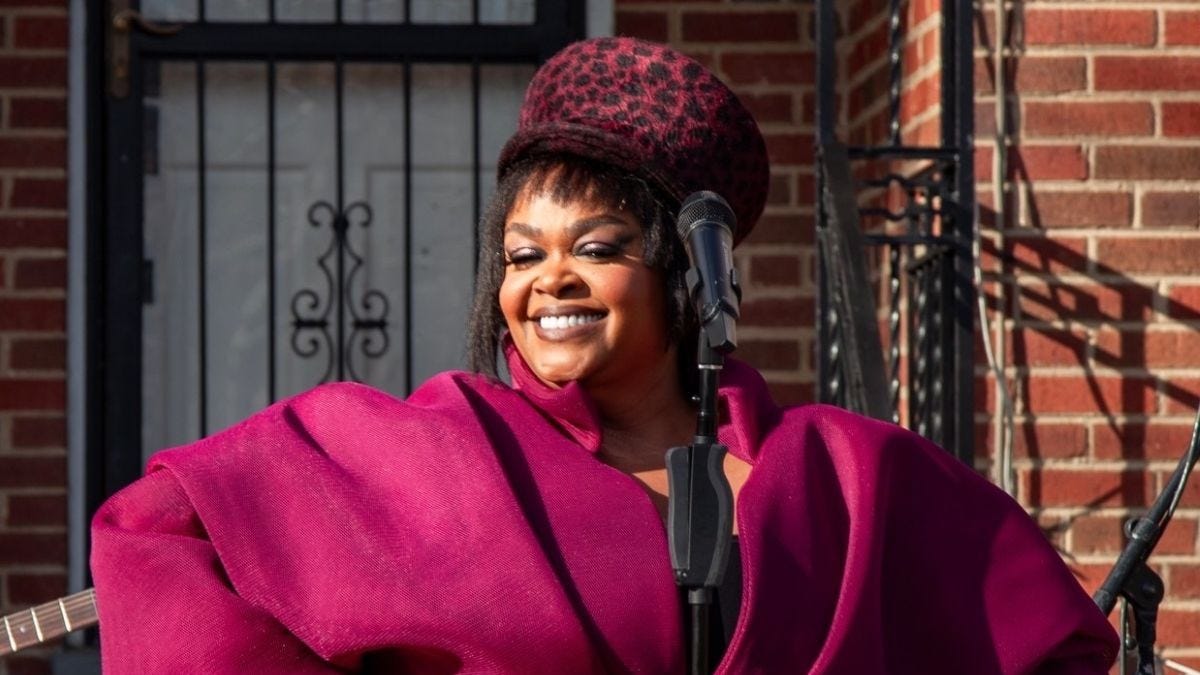
It has been lovely to witness a treasure like Jill Scott release a new, fresh project at 53 years old, more than 25 years into her career. And it has been especially moving to listen to the album during Black History Month. The first time I heard it, I knew the timing of the album was intentional and an act of love. What’s more, to truly love Black people means to understand and work toward a vision of the world where all Black people experience love, care, and ultimately liberation. It’s also been insightful to listen to the album while reading Everything for Everyone: An Oral History of the New York Commune, 2052–2072. The book makes clear that abolition is a politics of destruction, but one that is incomplete without a parallel politics that seeks to “preserve, liberate, and to lift up” new possibilities for living. Similarly, Black music has always done this work, preserving our histories, affirming our humanity, and sustaining us in ways that make freedom feel both imaginable and necessary. It keeps us rooted while also making us restless enough to challenge and dismantle the structures that harm us.
In my last Substack post, I made the point that art can encourage us during dark times. It can remind us of our humanity and, importantly, why it is necessary to resist domination and oppression. Jill Scott’s To Whom This May Concern is certainly art that is needed for the times we are in.
Thank you, Jilly from Philly.
Reminder: We’ll be gathering on the 24th to read Everything for Everyone together, joined by one the book’s authors, M. E. O’Brien, to imagine what a new world could look like and to talk about how we might actually get there. Register here.