

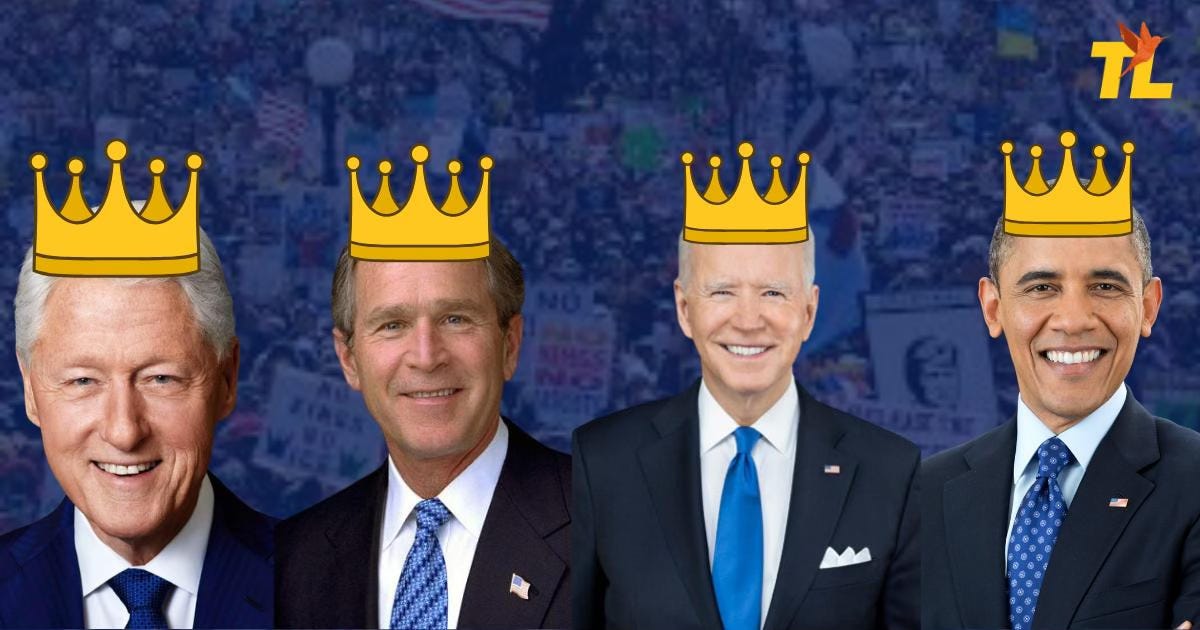
This weekend, millions of people took to the streets across the United States in what may become one of the largest protests in the country’s history. Under the banner “No Kings,” people gathered to reject authoritarianism and to insist that the United States is not—and should not become—a monarchy.
There is something powerful in that refusal. People are paying attention. People are mobilizing. But there is also something in the framing that I cannot ignore.
The idea behind “No Kings” rests on an assumption that is simply not true—that authoritarianism is new to the United States. That it arrives with a particular leader. That what we are witnessing now is a departure from what came before.
For many people—particularly Black, Indigenous, immigrant, and colonized communities—there is nothing new about this moment. The United States has always exercised authoritarian power—not as a deviation from democracy, but as a feature of empire. From its founding, the United States has functioned as an imperial project built through the dispossession of Indigenous land, the enslavement of Black people, and the expansion of its power through war, extraction, and global domination. What we call “democracy” has always existed within an imperial structure.
We do not have to look far back to see this.
Under Bill Clinton, the logic of empire was consolidated domestically through the expansion of the carceral state and the restructuring of economic policy. The 1994 crime bill accelerated mass incarceration, while welfare reform imposed new forms of economic discipline on poor families—particularly women of color—under the language of responsibility and independence.
Here, empire operated not through foreign invasion, but through internal regulation—managing populations through punishment and deprivation.
Under George W. Bush, these logics extended outward. The invasions of Iraq and Afghanistan projected U.S. power globally, while the expansion of surveillance, detention, and torture—Guantanamo Bay, extraordinary rendition, indefinite detention—made imperial authority explicit and publicly justified in the name of security.
Under Barack Obama, empire did not recede—it adapted. After the overt militarism of the Bush era, Obama’s presidency outwardly attempted to reclaim moral authority while continuing the same forms of violence that sustain imperial power. Drone warfare became a central tool of U.S. policy, enabling the projection of force across borders with minimal visibility and no meaningful accountability. In countries like Pakistan, Yemen, and Somalia, entire communities lived under the constant presence of drones, where decisions about life and death were made through secretive, bureaucratic processes far removed from public scrutiny. At the same time, the administration oversaw record numbers of deportations, extending the reach of imperial governance inward.
Under Joe Biden, these patterns did not fundamentally change. The U. S. continued to project military, political, and economic power globally while maintaining systems of control domestically. The administration’s support for Israel amid the genocide in Gaza reflected a broader imperial alignment—the use of U.S. resources to sustain state violence abroad while framing that support as necessary or defensive. Again, immigration enforcement regimes remained firmly in place.
Different administrations. Different rhetoric. But the same system. The current administration is not a story of democracy interrupted. It is a story of empire sustained.
What has changed is not the presence of authoritarian power, but who is forced to recognize it. When imperial violence is concentrated in Black communities, in immigrant detention centers, or in countries far from U.S. borders, it is often rendered invisible—explained away as security, as necessity. But when it begins to disrupt the expectations of those who have been more protected from it, it is suddenly named for what it is—authoritarianism.
This is not because the violence is new. It is because the recognition of it is.
That is why the language of “No Kings” feels incomplete. We say we do not want kings, as if the problem is monarchy itself. As if what we are resisting is the idea of a singular ruler with too much power.
But what do we call a system in which one person can authorize war across the globe, expand surveillance, detain and deport millions, and fund state violence with the stroke of a pen?
We call it a U. S. presidency.
And within an empire, that presidency functions much like a king. The United States does not have kings in name. But it has them in practice.
None of this is to dismiss what happened this weekend. But if the analysis stops at rejecting a single figure, or even a single administration, we risk misunderstanding the very thing we are trying to oppose.
The problem is not kings. The problem is empire and the systems of power that sustain it, regardless of who holds office. The question is not whether we reject kings. The question is whether we are willing to confront what has been here all along.
"This is not because the violence is new. It is because the recognition of it is."
Amen.
Yes to all of this. Folks who
have for too long benefitted from being in the status quo are holding on to the myth of US exceptionalism, can't acknowledge the emperor doesn't have clothes and can't cede their comfort for the greater good. We are in an empire in decline.