

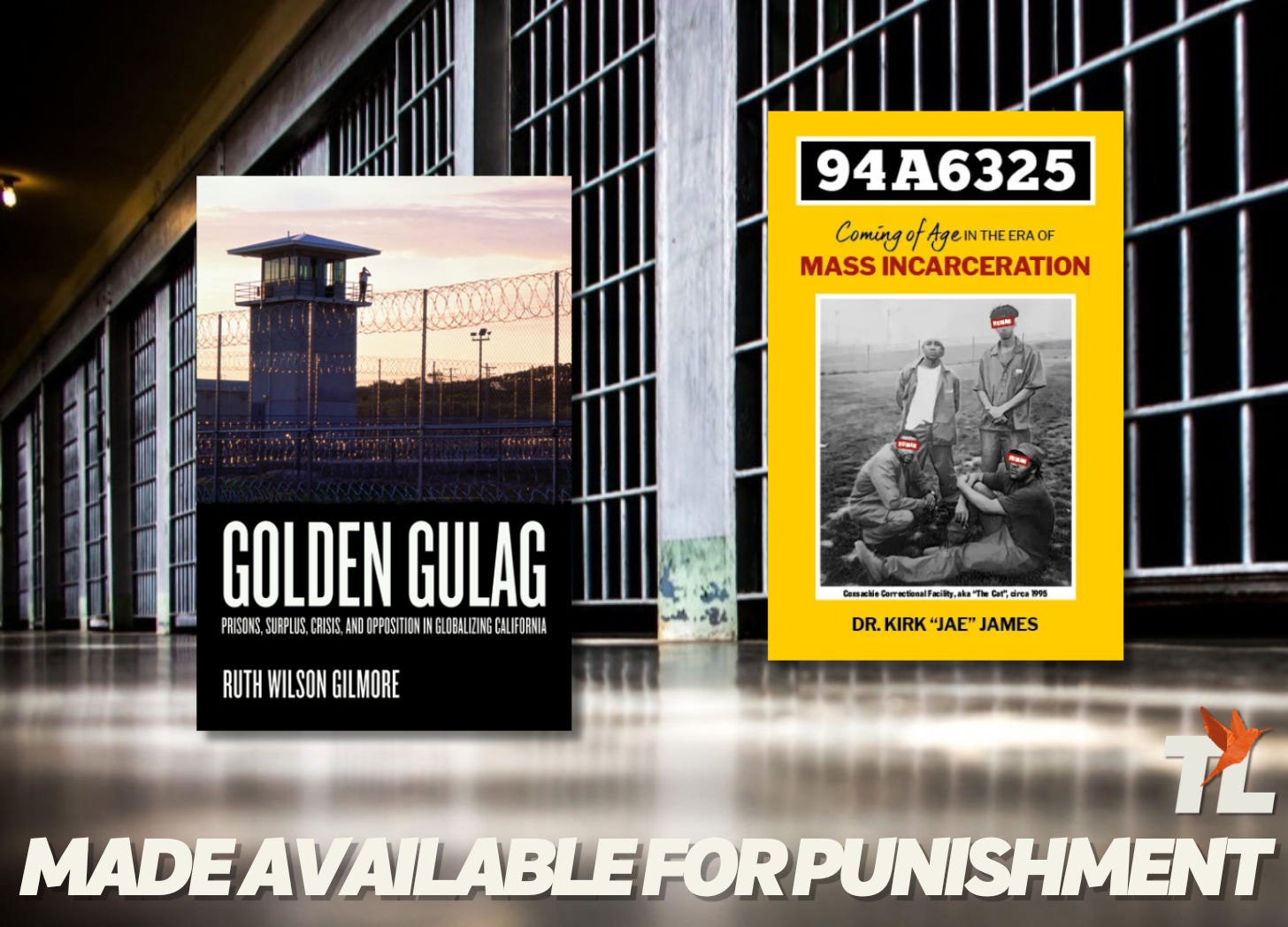
I’ve been spending the past several weeks re-reading Ruth Wilson Gilmore’s Golden Gulag as background for a new project I’m working on. One of the most important ideas I took from Golden Gulag—and one that has continued to shape my thinking—is Gilmore’s argument that prisons don’t emerge because crime somehow demands them. They emerge because states confront political and economic crises by expanding institutions of punishment. The prison is not a natural response to crime. It is a political project.
That idea kept returning to me as I read our summer reading selection, 94A6325: Coming of Age in the Era of Mass Incarceration, by Dr. Kirk “Jae” James.
As I read 94A6325, what stood out to me the most is the active role the state played before Jae was ever arrested. As he recounts in the book, he wasn’t already participating in the criminal activity that ultimately sent him to prison. An undercover police officer, posing as someone connected to him through his stepfather, repeatedly approached him with an opportunity to participate in a transaction involving drugs and guns. Jae initially refused. It was only after his financial circumstances became increasingly desperate that he agreed.
Since reading Golden Gulag for the first time several years ago, I’ve thought a lot about how systems of policing and punishment don’t simply respond to crime; they produce the conditions through which people become criminalized. What struck me about Jae’s account was how vividly it illustrated this reality—a reality that is often obscured. The state doesn’t stand outside crime waiting to punish it. The state is an active participant in creating the very circumstances that later justify punishment.
Most conversations about incarceration begin after a law has been broken. The questions become whether someone was guilty, whether punishment was justified, or whether a sentence was appropriate. Abolition invites us to begin this conversation earlier. It asks how particular people become available for punishment in the first place. It asks what political, economic, and social conditions make criminalization possible—and what role the state itself plays in producing those conditions.
Reading Jae’s memoir through the lens of Golden Gulag also connected his personal story to a broader theory of state power.
Ruth Wilson Gilmore argues that prisons are not simply buildings where people are confined. They are institutions created to absorb political, economic, and social crises. They are part of an expanding state capacity—a vast infrastructure of policing, prosecution, courts, prisons, probation, surveillance, and incarceration that requires continual justification and continual use. The important question is not why prisons exist, but how the state continually reproduces the conditions that make prisons appear necessary.
Another important idea that comes through again and again in Ruth Wilson Gilmore’s writing is her description of the relationship between organized abandonment and organized violence. States respond to political and economic crises in two ways. First comes organized abandonment—the systematic withdrawal of the conditions people need to flourish: stable employment, adequate housing, education, healthcare, and social support. Then comes organized violence—the expansion of policing, prosecution, surveillance, imprisonment, and other coercive institutions that manage the very crises abandonment helped produce.
Seen through that lens, Jae’s story is about much more than an undercover operation and entrapment. Before there was a criminal case, there was precarity. Before there was punishment, there were diminishing economic opportunities and growing financial need. Those conditions did not excuse the choices he ultimately made (as he says many times), but neither were they incidental to the story. They formed the terrain on which those choices became imaginable.
The undercover operation featured in Jae’s story is an expression of an expanding carceral state whose power lies not simply in responding to criminalized behavior but in organizing the social and institutional conditions through which criminalization becomes possible. Rather than waiting for a crime to occur, the police entered into a landscape already shaped by organized abandonment and helped transform precarity into a prosecutable offense. The result was another prosecution, another conviction, another prison sentence—another person made available for criminalization and absorbed into an institution whose legitimacy depends on a continual supply of people to prosecute and incarcerate.
Reading 94A6325 reminded me that abolition is not simply about imagining a world without prisons. It is about understanding—and ultimately dismantling—the political arrangements that first abandon people and then punish them for the conditions that abandonment creates.
These are some of the ideas I’m looking forward to discussing when Dr. Kirk “Jae” James joins us for our live Toward Liberation conversation on July 22. I hope you’ll read 94A6325 and join us (and as always if you haven’t finished reading—or even started reading—you’re still very welcome to join)!
In solidarity,
Alan
Most of what Dr. James spoke about was about the healing power of hip hop. I was wondering if you could speak to the politically conscious side of Hip-Hop and what it means for people who do not see the effects of a state that is under-funded and over-policed.
Also, what are you thoughts on bands that were a part of the "Native Tongues" collective like "A Tribe Called Quest" and "De La Soul"?