

We live in a moment saturated with the language of self-care. In popular culture, in activist spaces, and in everyday conversation, we’re encouraged to rest, to log off, to set boundaries, to protect our peace, and to withdraw from environments that cause harm. These practices are important. Survival often depends on our ability to create distance from the forces that deplete us. But much of the contemporary conversation about self-care assumes that harm can be avoided, or that threats can be managed simply by stepping away.
History suggests that these assumptions do not hold for everyone.
For many people—particularly those whose lives have been shaped by racial capitalism, colonialism, patriarchy, and state violence—harm is not something that can simply be avoided. It is structural. It is embedded in the institutions and systems that govern everyday life. In those conditions, the question of care becomes more complicated. What does self-care mean when harm cannot simply be escaped? What does care look like when survival itself is under threat?
Audre Lorde offered one of the most powerful reframings of self-care when she wrote:
“Caring for myself is not self-indulgence, it is self-preservation, and that is an act of political warfare.”
Lorde wrote these words while living with cancer as a Black lesbian feminist who understood that the state and the medical system were not built for her survival. Her insistence that self-care is political reframed care as a form of resistance.
But her words also invite some harder questions. If self-care is political warfare, what happens when care requires more than rest, reflection, or withdrawal? What happens when care requires defense?
We are often taught to think of violence as morally simple. Violence is condemned as inherently wrong, while peace and nonviolence are framed as the only legitimate forms of resistance. At the same time, states maintain a near-monopoly on violence while claiming that this violence exists to ensure public safety. Police use force in the name of protection. Prisons cage human beings in the name of order. Child welfare systems separate families in the name of care.
Yet when individuals or communities defend themselves against harm, that defense is recast as criminality or extremism.
In We Refuse: A Forceful History of Black Resistance, Kellie Carter Jackson challenges the familiar story that reduces Black resistance to a binary between Martin Luther King Jr.’s nonviolence and Malcolm X’s militancy. Through a range of historical examples, she shows that Black resistance has always included a broader spectrum of strategies, many of which were fundamentally protective in nature.
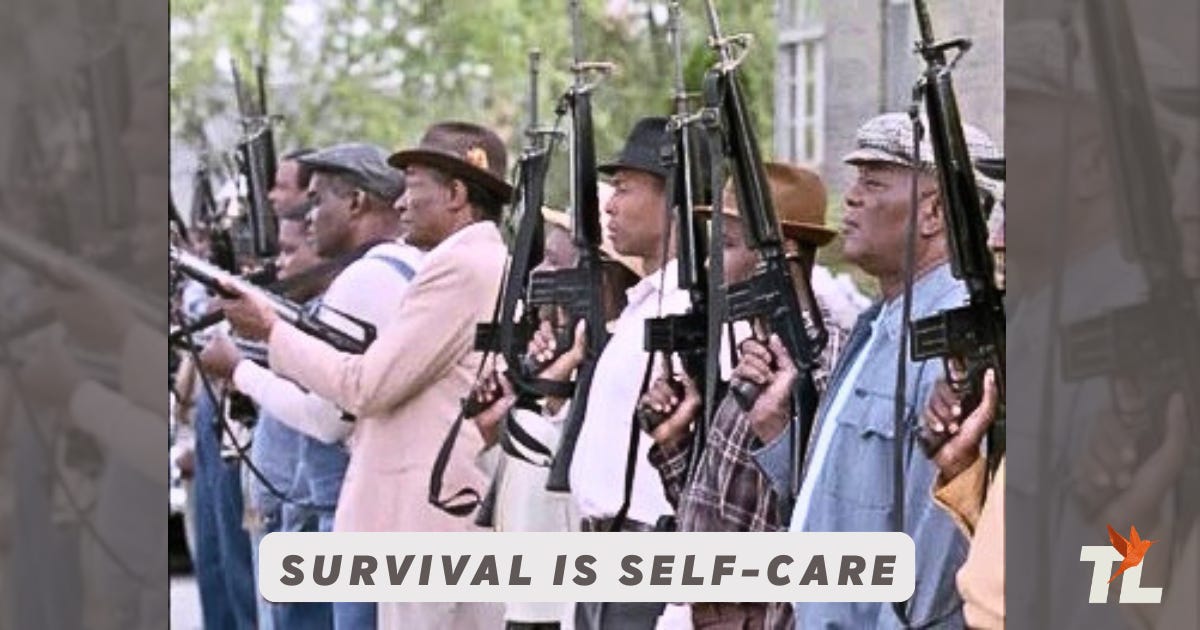
Enslaved people who revolted against their enslavers were not seeking domination; they were resisting brutality. Black women who fought back against sexual assault were defending their bodily autonomy in a society that denied them protection. Communities that armed themselves during Reconstruction and Jim Crow did so because the state either refused to protect them or actively participated in their terrorization.
In these contexts, force functioned less as a weapon of aggression than as a shield. It was a way of protecting families from lynching, safeguarding homes from night riders, and asserting that Black life had value even in a society structured to deny that truth.
Understanding this history rejects the narrative that frames all violence as inherently unjust. It suggests instead that self-defense has often been an expression of care—care for one’s body, one’s family, and one’s community.
Charles E. Cobb Jr. explored this protective tradition in This Nonviolent Stuff’ll Get You Killed. His work reveals a truth often left out of civil rights mythology—nonviolent protest in the South was frequently sustained by armed Black communities who were prepared to defend activists and their neighbors. Movement workers slept in homes where shotguns rested by the door. Families organized patrols. Local people—many of whom would never appear in history books—stood watch. Nonviolence did not operate in isolation from violence. It was often possible only because others were willing to defend their communities and ensure that terror did not go unanswered.
In one of my favorite books, The Wretched of the Earth, Frantz Fanon pushed this analysis further in the context of anti-colonial struggle. Colonialism, he argued, is itself violent—not only materially, but psychologically. It trains the colonized to internalize inferiority and submission. Under such conditions, resistance can take on a deeply psychological dimension. For Fanon, acts of resistance—even when forceful—could disrupt the internalization of inferiority and submission that colonial violence sought to produce. By refusing submission, the colonized could begin to reclaim a sense of agency, dignity, and collective power.
Fanon didn’t claim that violence was inherently liberatory, nor did he ignore the devastation violence can produce. But he insisted that when people live under conditions of constant domination, resisting that domination can be restorative. Resistance can break the psychic grip of oppression by transforming people from passive objects of violence into agents capable of shaping their own fate. For those whose lives are structured by humiliation, degradation, and threat, refusing domination—even forcefully—can become a way of reclaiming humanity.
These historical traditions are not confined to the past. Survivors of gender-based violence, for example, are often told that the only legitimate response to assault is endurance followed by legal recourse through systems that frequently fail to deliver justice. Yet many survivors who defend themselves in the moment—who fight back against an attacker in order to survive—find themselves criminalized rather than protected. The moral expectation of passivity persists even when passivity would mean continued harm.
Around the world, people living under military occupation face an even more extreme version of this dilemma. When entire communities are subjected to displacement, bombardment, and siege, the question of self-defense becomes unavoidable. Yet the violence of resistance is often immediately condemned, while the structural violence that produced these conditions in the first place remains normalized or ignored. Palestine is one of the clearest examples today, but it is not the only one. Across the world, people subjected to occupation and domination are routinely denied the moral language of defense.
These situations differ in many ways, but they share a common feature—the people most exposed to violence are often denied the legitimacy of protecting themselves from it.
In our current culture, self-care is frequently framed as a form of personal wellness that allows individuals to cope with stress while leaving the broader structures of power intact. But this is a narrow understanding of care.
Care can also mean protecting one’s body from assault, protecting one’s children from terror, protecting one’s community from annihilation, and refusing the inevitability of harm.
None of this is an argument for romanticizing violence. It is not a dismissal of nonviolent struggle, which has transformed the world in profound ways. But an honest conversation about care requires acknowledging the conditions under which many people struggle simply to survive. Self-care may sometimes involve rest and restoration. But it may also involve protection, resistance, and refusal.
If caring for oneself is an act of political warfare, then we must also confront the realities that such warfare entails. Not because violence is virtuous. But because survival is.
"Survivors of gender-based violence, for example, are often told that the only legitimate response to assault is endurance followed by legal recourse through systems that frequently fail to deliver justice. Yet many survivors who defend themselves in the moment—who fight back against an attacker in order to survive—find themselves criminalized rather than protected. The moral expectation of passivity persists even when passivity would mean continued harm."
I always appreciate your thoughtful posts, and I especially appreciated you highlighting both the micro and macro examples.