

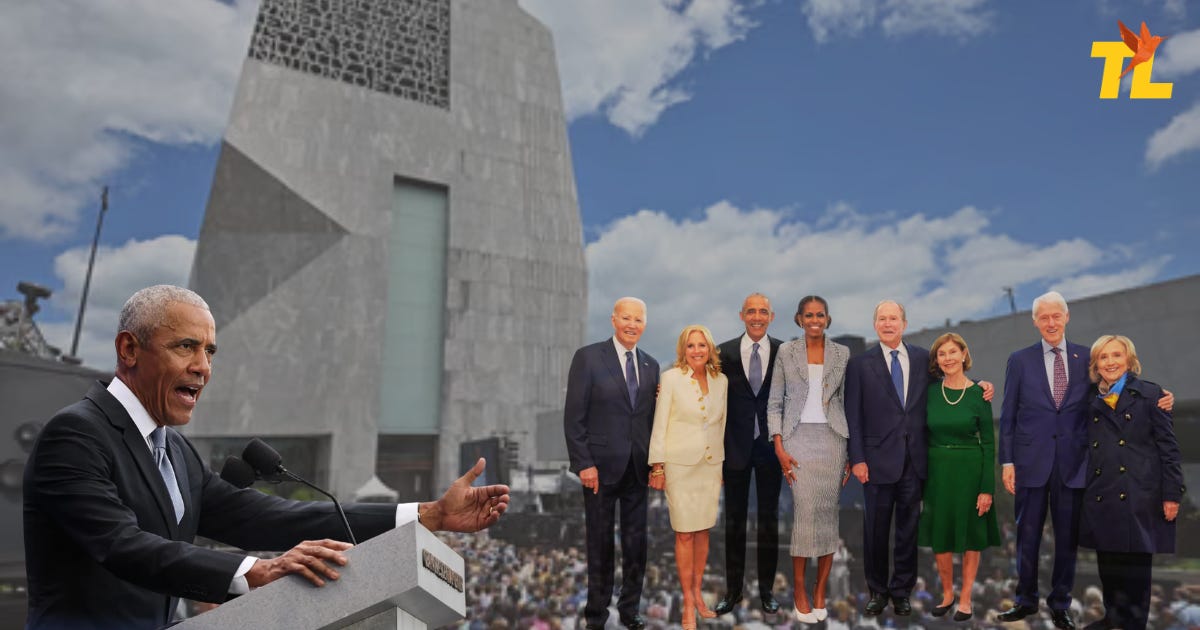
I’ll begin with but won’t tarry longon the death of Lindsey Graham over the weekend. His abhorrent legacy as a U.S. senator from South Carolina is well documented. Some of his most recent and egregious acts can be found here, here, and here. He was no friend, and even more accurately, a formidable foe to marginalized people in America and every other place his war hawkish proclivities wreaked havoc. In recent years, he spoke of the War on Gaza:

It is no exaggeration to say that the policies he advanced and the obstruction he caused in the US Supreme Court* are directly responsible for a massive amount of premature death domestically and globally.
*And though the Supreme Court will not save us as Alan deftly explains in this piece, it is worth noting the immediate harm Graham’s dealings caused that continue to reverberate as rights are stripped away and the power of the executive branch is expanded.*
The much more curious thing to ponder is Senator Corey Booker’s (D-NJ) sprint to memorialize Graham in the hours after his death in a bizarre effort to humanize a man whose contributions as a politician were so destructive. Booker’s tribute recounts a personal experience working with Graham to pass the First Step Act, a criminal justice reform bill.
But what does highlighting Graham’s role in a singular piece of legislation, no matter how helpful, mean when considering the overwhelming majority of his career, where he advanced policies that did just the opposite?
The tribute says far more about Booker than Graham.
Booker, like many other “Black faces in high places” to borrow Ruha Benjamin’s term, routinely engages in a process of normalizing and humanizing people like Graham or even Trump in the losing game of proving the legitimacy of operating at a table the likes of Graham or Trump don’t even believe they should be sitting at.
An even better example than Booker’s tribute to Graham was President Obama’s appearance at Trump’s inauguration.
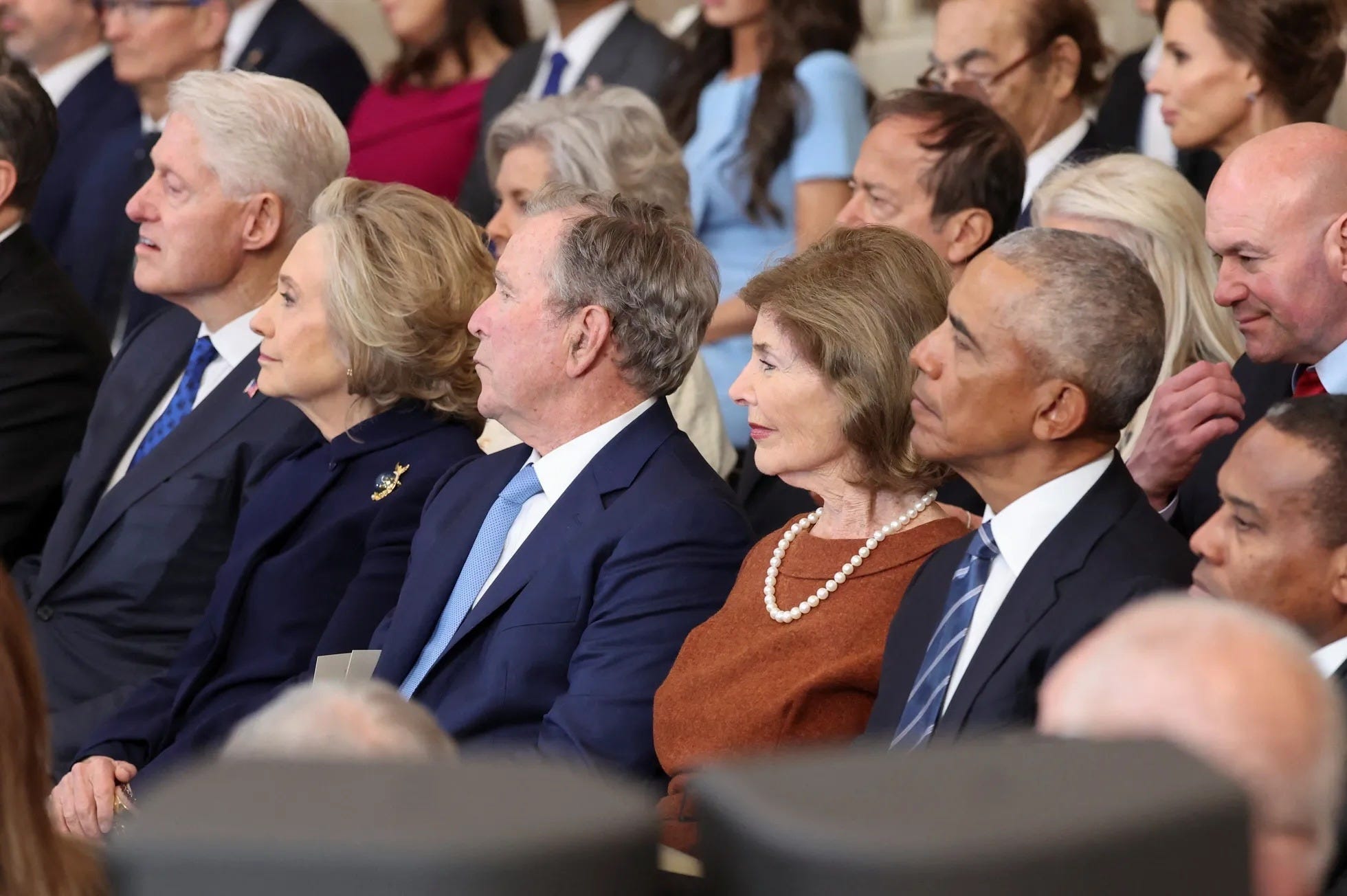
It was an appearance his wife, Former First Lady Michelle Obama, declined to make. She was quoted as saying, she was “growing tired of ‘doing the right thing’: it’ll never be enough.”
And she’s right. Her comments echoed the wisdom Toni Morrison shared in 1975 at a keynote address at Portland State University:
“The function, the very serious function of racism is distraction. It keeps you from doing your work. It keeps you explaining, over and over again, your reason for being. Somebody says you have no language and you spend twenty years proving that you do. Somebody says your head isn’t shaped properly so you have scientists working on the fact that it is. Somebody says you have no art, so you dredge that up. Somebody says you have no kingdoms, so you dredge that up. None of this is necessary. There will always be one more thing.” -Toni Morrison
What both Michelle Obama and Toni Morrison named is the futility of trying to prove their worth to those hell-bent against seeing their humanity.
And yet, time and again, we see attempts at the root of what ultimately amounts to aligning with, and thereby normalizing, Empire in the name of PROOF.
Which brings me back to Obama and last month’s opening of the Obama Presidential Library on Chicago’s South Side. There have been many criticisms of the library in the run-up to its opening, including gentrification, displacement, and rising tax rates for neighborhood residents.
But despite the economic realities residents are navigating, overwhelmingly, most Chicagoans felt proud that Obama’s Presidential library found a home in their city.
And that echoes the sentiment most Black people hold about Obama. The feeling of pride, particularly among Black elders, makes critiquing him impossible and flat-out painful. For them, he is, and perhaps always will be, the embodiment of the impossible made possible, which engrains a sense of immense and resolute pride.
But how Black people evaluate Obama is driven by a generations-long hunger for belonging, affirmation, and recognition that overshadows what actually happened during his Presidency. That’s why there is little patience and almost no ear for any criticism of Obama. And that is especially the countenance of Black Americans born before the Civil Rights era. He is the symbol that he, and therefore we, made it. Obama is the PROOF that Black people are, in fact, good enough. Proving that they were good enough was what a generation had been born trying to prove in order to attend school or get a job, or make their way into the spaces and places White America was constantly and often violently trying to keep them out of.
So when Obama enters the chat, suddenly objectivity exits, and we are no longer calling a thing a thing. And I argue that it has everything to do with what he symbolizes in terms of pride and proof.
There is such a deep, and I would argue, subconscious hunger for belonging that the pomp and circumstance of it all obscures the realities of the American Presidency. ANY American Presidency. And yes, the man did his job under the most trying circumstances and hateful racism. So hated was he that he sparked the movement that brought us first the Tea Party and eventually Trump. Driven by a protective reflex to protect a beautiful and brilliant Black family who by every standard PROVES, or we think proves, our worth to the White gaze, the flanks around the Obamas are tight. To be clear, they deserve protection from the vile filth of the worst racists and bigots.
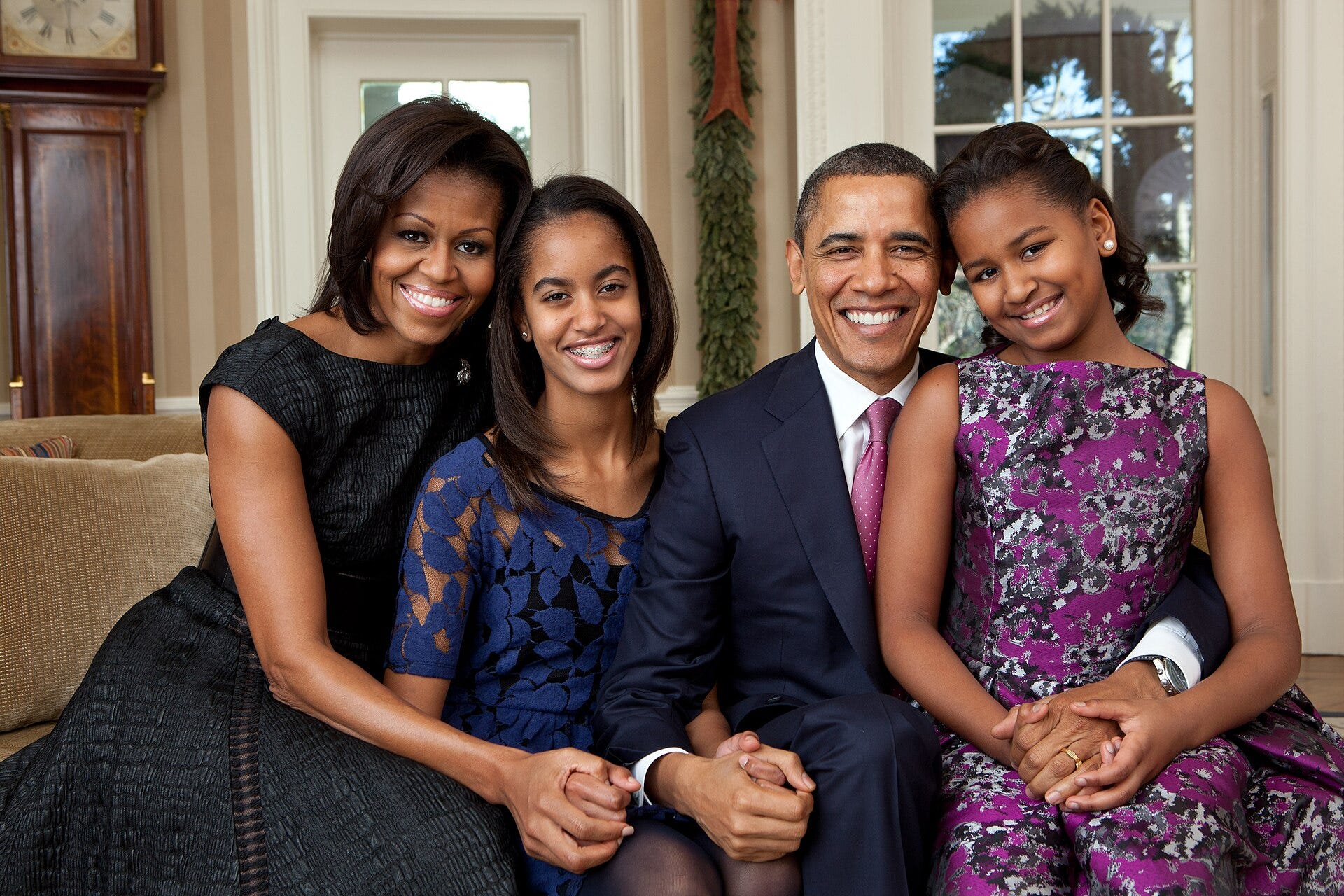
And here’s where it’s critical to separate Obama as a President from Obama as a Black husband and father, for it is truly beautiful and inspiring to see Black love in technicolor. A major tool of oppression has been the deliberate and violently executed efforts to undermine and destroy Black love through family separations beginning during the period of enslavement up through the current family policing system, welfare policies, and mass incarceration as recounted by Dr. Kirk “Jae” James in 94A6325, our summer read. In the face of such terror, to have the Obama family’s love and devotion centered will always be a source of pride that Black love has and will endure. It is something to be celebrated and admired. And yet, that is separate and apart from the job of American President.
While the display of the Obamas as a symbol of Black Love can be seen as revolutionary, the office he held isn’t and never can be.
And that’s also exactly why the pride in Obama needs to be critiqued, but even more importantly, unpacked.
Despite being a “Black face in ‘the highest’ place”, Obama never stood the slightest chance of effecting radical change. And that’s what we need, a radical, revolutionary change to the systems that oppress us.
Allegiance to Obama is rooted in a sense of pride because he’s proof. This is evidenced by the way he and his family are described as smart, polished, and respectful.
It says, without saying, “Look at us. See, Black people are as good as White people.”
But we must reject the tendency to prove our worth.
There will always be one more thing.
And even more importantly, Black people are worthy without anyone’s co-sign or permission.
That’s what I want Black people to understand deep down in our souls. Our worth shouldn’t and can’t be measured by how we show up to the White gaze, nor as a response to their worst stereotypes of us. They’ve been dehumanizing us from the moment we arrived in America. And we should never be in the business of proving ourselves to people who don’t see us as fully human.
Generations believed the lie that we must prove we’re just as good, and many still hold on to its vestiges. That’s the basis of respectability politics. To try and prove our worth by how we look, dress, and sound, what titles we hold, and how adept we are at assimilating.
But when pride and proof are cast aside, we can honestly examine Obama’s legacy and his role in upholding, maintaining, and even advancing the Empire. But to do that, we first have to accept that the job of any American President, including Obama, is to do just that.
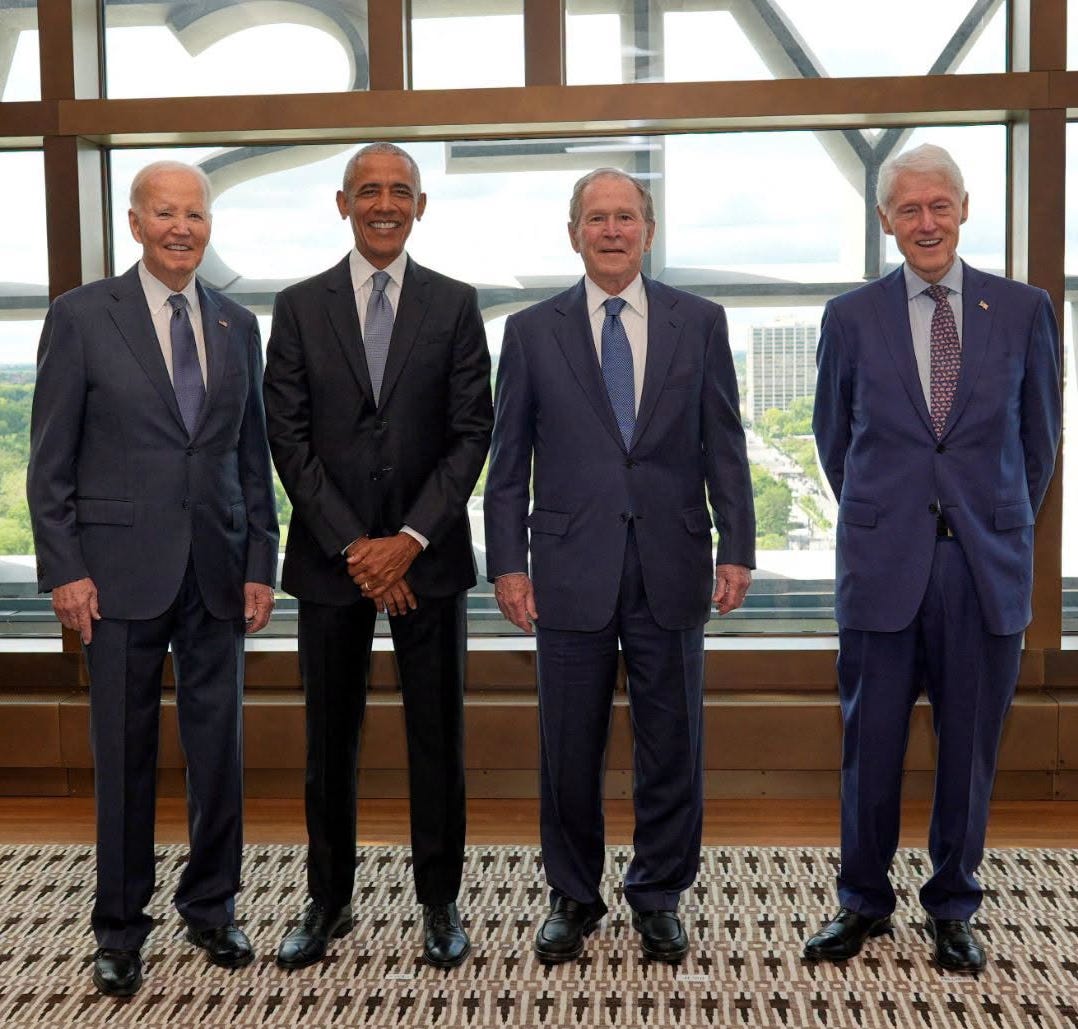
The symbolism Black people have attached to Obama is secondary to his first role as head of Empire. This picture from the library’s opening says this better than anything else. Here he is on equal standing with his peers. Without Obama and Michelle in the frame, it is absolutely clear what we are looking at. American Presidents are and have always been the architects of destruction and responsible for some of the most devastating policies that have destroyed American communities, wrecked working-class families, and inflicted global terror. No one would bat an eye in admitting that as truth in the legacies of Biden, Clinton, and most certainly Bush, whose image has been disturbingly sanitized from appearances with Michelle Obama.
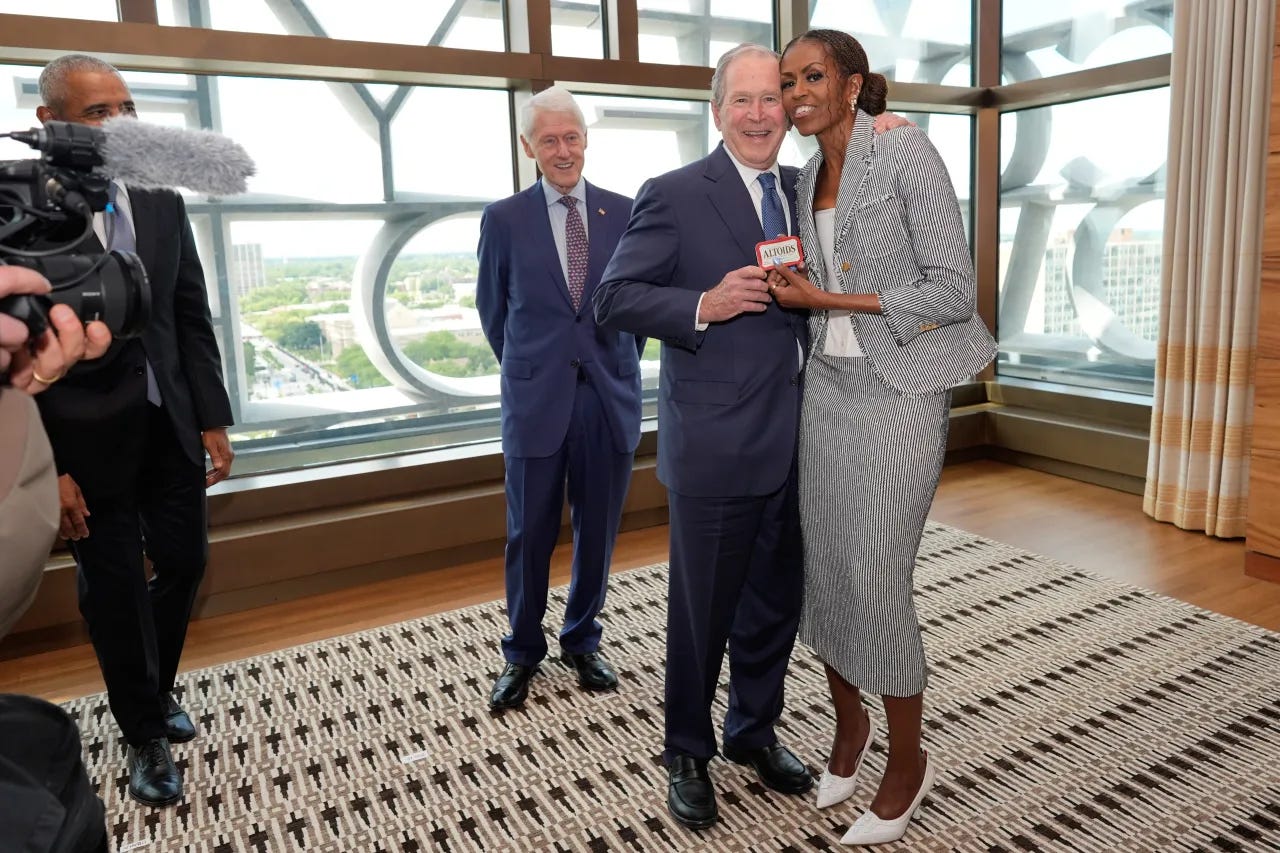
Side note: It is rather telling, and I’ll even go so far as to call it sickening, how George W. Bush’s apparent fascination with Michelle Obama has seemed to make some people forget how vile he was in office. Throughout both of Obama’s terms, the interactions between the two, documented in appearances and photos, gave the impression of an authentic friendship, or at least a mutual fondness. The lies, the invasion of Iraq, all of the Children Left Behind under his presidency, were suddenly forgotten with the memes of them cracking jokes and passing some mints. With glee, people, including Michelle Obama, seemed to be tickled by their unexpected congeniality. What it actually served to do was sanitize his actual legacy. But the uncomfortable truth is that part of the fascination was rooted in the surprise that he would be so enthralled. But why should that even be shocking? Unless interpreted as another instance of PROOF that Michelle Obama, and therefore we, are worthy under the White gaze.
And yet, we can’t allow that to obscure the realities of Obama’s legacy as President, and perhaps even more importantly, allow his ascension to that office to sanitize what Empire does and has always done to wreak havoc domestically and globally. Empire is gon empire, and as Ruha Benjamin so poignantly reminds:
“Black faces in high places are not going to save us.”
The reason many find it hard to accept even the most basic critique of Obama’s legacy is because of that hunger for belonging and acceptance. But that hunger is rooted in anti-Blackness. Now, to be clear, I don’t blame Black people, particularly our elders, who have endured the psychic casualties of a lifetime of dehumanization. But we have to move toward recognizing the truth of the American Empire, and then toward reconciling that Obama played his part in advancing it in ways that were harmful and destructive. And to be brutally honest, his legacy includes laying the foundation for much of what Trump has been accomplishing today.
Once we reconcile and unpack the pride Obama evokes, we’ll be clearer about what must also be rejected. And that will bring us closer to unapologetically requiring that leaders insist on radical change. We will also know that we should never attempt to prove our worth and that we must insist only on our resilience and dedication to Black love.
Let our love be ever radical,
connease
—
I hope you’ll join us on Wednesday, July 22, at 6:00 PM Eastern for our zoom discussion of 94A3625. This month we’re very honored to be joined by Dr. Kirk “Jae” James.