

For some time now, I’ve been convinced that the world we’re working toward—one without cages, borders, family policing, or organized abandonment—will not be delivered through the familiar channels of protests or electoral politics. Those tools have mattered, but they have never been enough. History shows us that abolitionist futures are not granted; they are wrested into being through rupture. Through revolution. And revolution, if we’re honest, carries implications that are unsettling, including confrontation and violence, not because we desire harm, but because systems built on violence rarely dissolve peacefully.
This recognition isn’t meant to frame revolution as something to fear. It’s meant to be clear-eyed about what we’re up against. Carceral systems, racial capitalism, and empire have proven extraordinarily adaptable. They absorb dissent. They professionalize resistance. They promise reform while preserving power. If abolition is our horizon, then we must be willing to imagine transformation at a scale that radically exceeds reform—and that necessarily means the dismantling of capitalism itself. An economic system built on extraction, disposability, and inequality can never be reconciled with collective care, mutual flourishing, or liberation.
And yet, even when we name all of this, a persistent question remains: How do we get there? What does life actually look like on the other side of capitalism? How do people survive the collapse of one world while building another? What kinds of relationships, conflicts, mistakes, and experiments emerge in the aftermath of revolution?
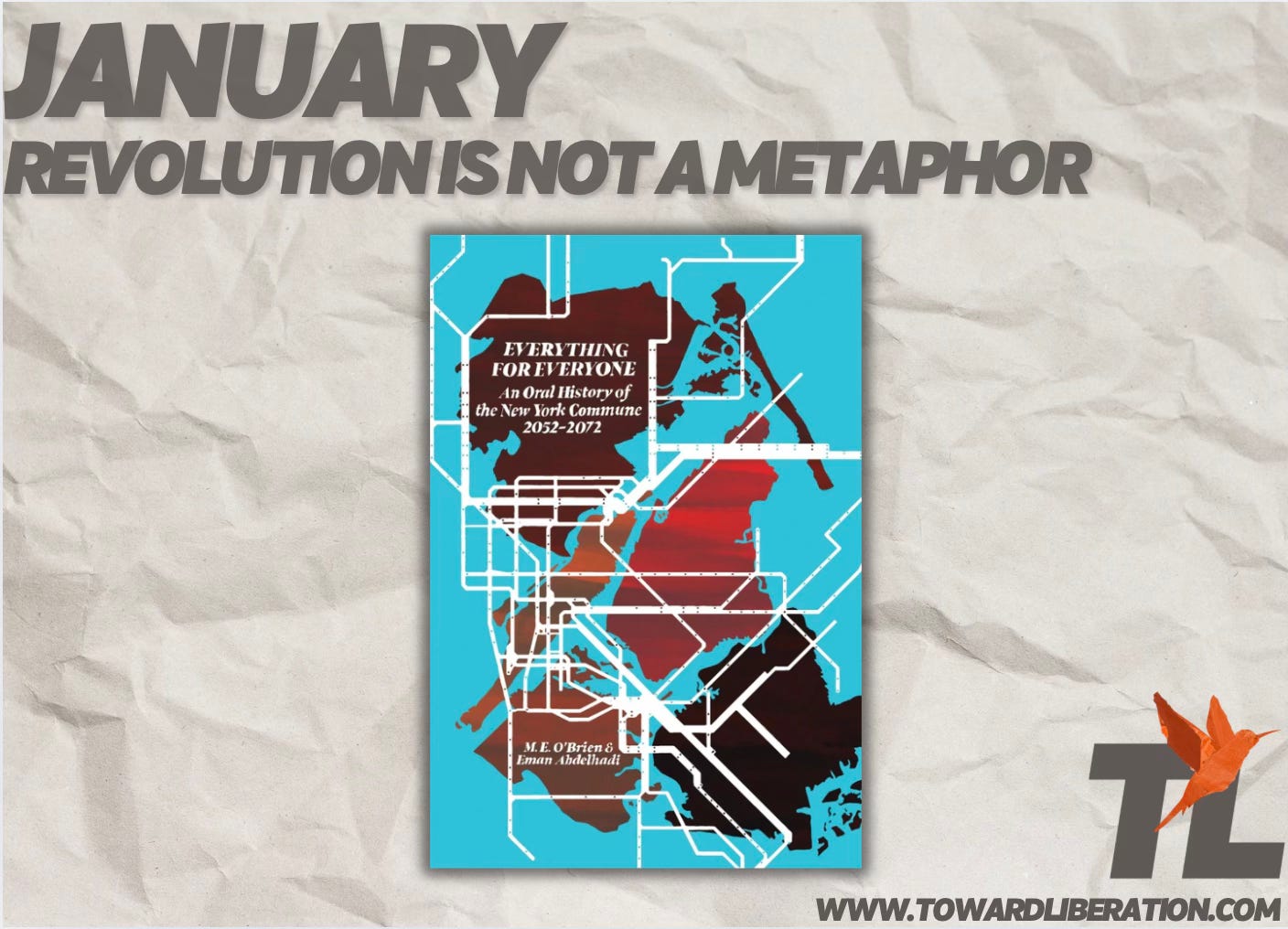
That’s why we chose Everything for Everyone: An Oral History of the New York Commune, 2052–2072 for our January–February reading. Rather than offering a blueprint or manifesto, this book invites us into a speculative future through an oral history of the New York Commune, decades after a successful uprising. We hear from people who lived through the insurrection, the uncertainty, and the everyday work of building a new society. The book refuses easy answers. It doesn’t sanitize struggle or pretend that liberation is tidy. Instead, it gives us something arguably more valuable—a textured, human account of what it might actually take to undo capitalism and construct collective life beyond it.
Reading this book together is an exercise in political imagination. It’s an opportunity to stretch beyond critique and ask harder questions about responsibility, sacrifice, joy, and solidarity. What happens after the streets empty? How do we care for one another when the old infrastructures are gone? How do we resolve conflict without reverting to punishment? What does “everything for everyone” demand of us?
In addition to sharing our next read, I want to share a small but important shift in how our group will move forward. Beginning now, we’ll be taking two months to read each book instead of one. Many of you—and honestly, all of us—have shared that the monthly pace has been difficult to sustain. Slowing down feels aligned with the kind of movement culture we’re trying to build—one that values care, depth, and accessibility over constant acceleration.
I’ll end with this invitation. Imagining abolitionist futures can be frightening. It asks us to let go of the familiar, even when the familiar is harming us. But it’s also an act of courage and collective hope. The kind of radical imagining this book offers isn’t escapism—it’s preparation. If we are serious about moving toward liberation, then we have to practice imagining worlds that don’t yet exist, together. I hope you’ll join us as we do that.
In solidarity,
Alan
P.S. At the publisher’s website (here), a digital copy of the book is available for only $5.00.
It’s a great book. I’ve not read it straight through, focusing on the Bay Ridge Commune and the story of how Palestine gets free by reading it multiple times.
Hi! When does the group meet?