

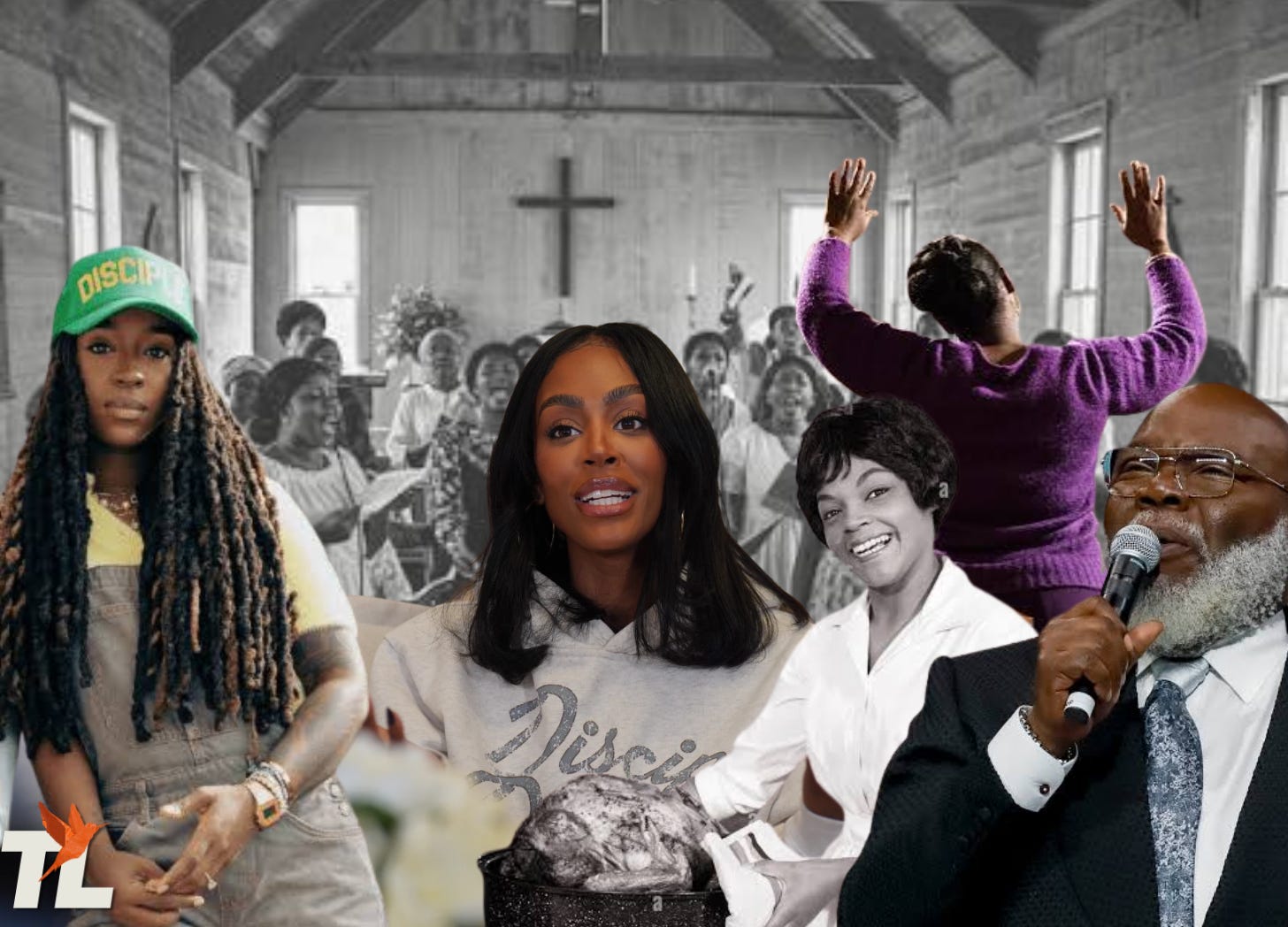
I’ve been thinking about God and religion lately. Over the past year or two or three, there seems to be a shift happening. Admittedly, this shift could be what I’ve noticed in my own community and personal life, but I am inclined to see it as either a wider phenomena or at least a microcosm of one: people are increasingly more Christian. And if people are not increasing in their religion per say, they are at least performing their religion louder these days. While these observations are not limited to the internet, the internet does make a case that’s hard to ignore. There’s the well-documented rise of Christian influencers. A few years ago, there was also a wave of folks denouncing their sororities and fraternities, claiming they were demonic. There’s also a noted trend of influencers giving up their lifestyle content for a pivot to Christian content. And, I’d be remiss not to note the rise of the trad wife in recent years, which is inextricably tied to a performance of “Christian” values.
Some polls show that these observations exist beyond my algorithm: a 2025 Pew Research poll finds that in recent years, growing shares of the population have a positive view of religion’s role in society. The same survey also finds that nearly 60% of adults say that mainstream culture is at odds with their religious beliefs. The resurgence of the dominance of Christianity happening within the context of the rise of far right Christian nationalism in the United States, is at a minimum, an uncanny coincidence. I wonder how much our beliefs are influenced by our political environment, even if subconsciously. We should undoubtedly question what it means to see a rise in Christian values concurrent with a second presidency of Donald Trump, rollbacks to protections for trans people, and the increasing criminalization and surveillance of racialized communities.
These thoughts have brought me back to a term I think is discussed far too infrequently: Christian hegemony. Hegemony refers to the dominance of a world view or social norms in ways that silence alternatives. Hegemonic power is particularly corrosive because it is largely invisible; people simply accept the way things are as the norm. The dominance of certain ideas, attitudes, and beliefs are thought to be common sense. When it comes to Christianity, this means that Christian values, norms, beliefs, and attitudes become the unquestioned default, while ideas and expressions outside this realm are demonized.
I understand why conversations about Christian hegemony happen too infrequently. It is admittedly hard to talk about religion in the United States in general. The majority of the U.S. population identifies as Christian. Black people in particular are very religious; Black Americans are more religious than Americans of other races and ethnicities. In particular Black women, whose leadership has anchored and propelled social movements, are especially religious. It’s also impossible to ignore the role that the church played in freedom struggles. The commitment to Christianity is both cultural and personal and at the same time deeply tied to Black American history in the United States. I also think that a culture of rampant individualism obscures the connection between something like our own religious practice, which feels deeply personal, and the broader systemic impact the institution of Christianity has on society at large. I’d also argue that the hegemonic nature of Christianity is also precisely what makes it hard to discuss critically. It is difficult to talk about power structures that by design don’t tolerate questioning. How can we be critical of something that cannot be questioned? And what does it mean to be critical of something that makes us feel good? That provides so much comfort?
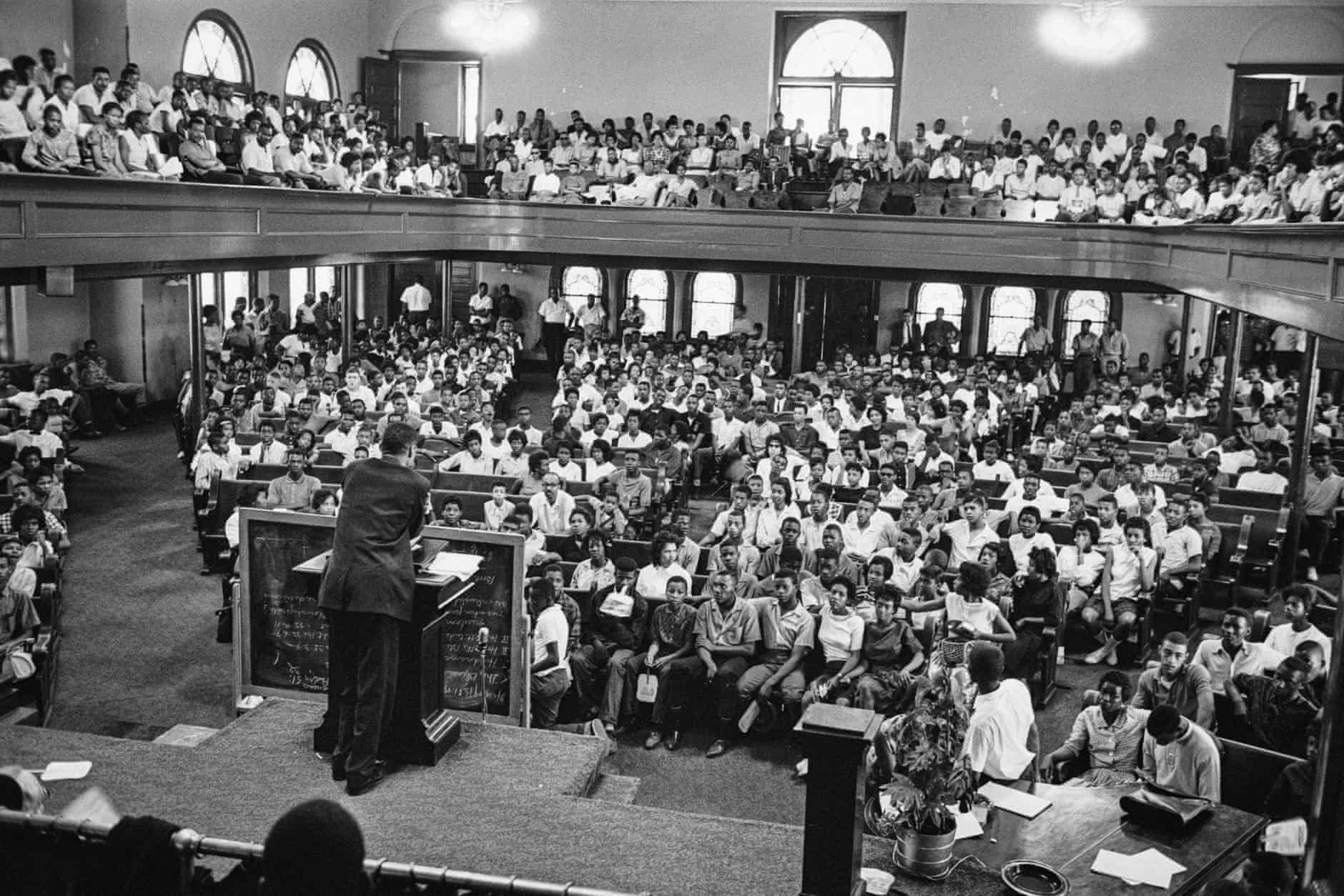
However, we are far beyond the Christianity and church that buoyed political movements in the 60s. There’s the understandable impulse to separate the Christianity that many Black Christians practice with the far right expressions of the religion, particularly the Christian nationalist movement. It’s common to hear that Christian nationalists are misusing the word of God or practicing Christianity wrong. And to be clear there are real distinctions to be made between far right Christian nationalism and Black communities practicing Christianity across the country. But, if we are truly honest, we must also be critical of the places where these traditions collide. There is a way that Christianity creates conditions for far right movements to prosper that must be addressed. And so, the question becomes: what do we make of the moments when Black Christians and Christian nationalists arrive at some of the same conclusions?
Take for instance, the popular and highly influential Jackie Hill Perry. Between Instagram and Youtube, Perry and her husband have nearly or just over a million followers. Perry’s testimony about rejecting homosexuality in service of God is controversial, but it has also found a large and receptive audience. Her performance at the 56th Gospel Music Association’s Dove Awards shows how ideas that repackage the logic underlying harmful practices such as conversion therapy can exist beyond the margins, within mainstream Black Christian thought. Her popularity normalizes the belief that gay and queer people are sinful and that queerness is something a person should resist and overcome, a conclusion shared by many conservative Christians and Christian nationalists.
Similar overlaps appear elsewhere. I’m considering churches who encourage their congregations to not get abortions (and oppose them) as a matter of religion. Or, consider the waves of women online talking about the dangers of birth control. Not all of these women are explicitly Christian, but Christian values, in particular the idea that women’s purpose is tied to reproduction, makes it easier to hear these arguments and be swayed by them rather than being immediately skeptical. Some Black Christians celebrated or at least are not opposed to Christian nationalist wins such as Texas making certain teachings in the bible mandatory in schools. There’s also the link between prosperity gospel and keeping people bought into the system of capitalism, even as this very system destroys Black communities. In prosperity theology, wealth is framed as evidence of God’s favor or proper devotion to him. Exploitative systems are not treated as the cause for financial precarity, instead people are encouraged to believe that their faithfulness will allow them to prosper within them.
This is what makes Christian hegemony so slippery. It can reorder people’s political commitments entirely, making religious allegiance more important than solidarity with people (and by extension oneself) experiencing oppression along the lines of race, class, gender, or sexuality. It encourages people to understand themselves as Christians before (and at times the expense of) understanding themselves as member of other communities with competing political needs. Christian hegemony encourages us to identify as Christian before we identify as anything else.
I am therefore increasingly skeptical of the impulse to altogether separate Black Christianity from far right Christian nationalism. The point is not that they are identical. The more useful task is to examine where they intersect and how widely accepted Christian values might make Black people more receptive to parts of the Christian nationalist agenda. At a moment where authoritarianism and fascism are gaining meaningful ground in the United States, we must be rigorous in examining how our own beliefs may help sustain them.
Importantly, I’d also argue that Christian hegemony does not require all of us to be Christian in order for it to consume our thinking. This is precisely why I believe it is critical to name its influence in this political moment. Hegemony, after all, isn’t really about belief. It’s more interested in dominance. And the question becomes: what does hegemony do but constrain our ability to imagine alternatives?
I’d argue that this way of thinking — here I’ll call them hegemonic logics — permeates all of our collective imaginations. Take for example prisons, policing, and the carceral state writ large. We are reluctant to let these systems of power go in part because they’ve also been around as the norm and they offer a certain emotional satisfaction, despite the harm they cause. They assure us that evil will be punished and that good people will be separated from bad ones, a logic that bears an eerie resemblance to the division between heaven and hell. They promise a neat and seemingly just resolution for the messiness and complexities of human life. So, why then, are we so hesitant to let go of systems of power despite their noted harm? Because they promise protection, even as they cause harm? I suspect the answer with Christianity and the answer with policing are more related than we like to admit.
If Christian hegemony has shaped our thinking deeply, it’s also worth asking what other logics it braids itself to. Consider surveillance. I’m interested in how the idea that God is always watching and all knowing and that we are never unseen and always subject to judgement finds its “secular” twin in the state. God becomes the state. The state becomes God. Because the United States is so thoroughly entangled in Christianity — from the country’s foundation, to slavery, to Native genocide — it becomes hard to make distinctions between religious authority and the state. Is it hard to imagine a world in which the state does not exist as we know it now because we simply accept that the state must always exist? I don’t know the answer to that question but I’ll be thinking about it for a while.
What I believe hegemonic logics most reliably produces and what must be fought inside of us is a posture of inflexibility. Put another way, they cultivate an instinct toward deference and submission in all of us, to God, to the state, or whatever entity exercises power over our lives. Rather than encouraging us to be expansive and inquisitive, or to generate new and more liberated ways of thinking and being, these hegemonic logics foreclose possibility.
Christian hegemony isn’t only out there in institutions and elections, although that is where its consequences are most frightening. It also lives within us shaping how we understand ourselves and how we treat others, whether or not we call ourselves Christian. It’s the quiet voice that tells us our suffering is deserved or meaningful. It’s in the assumption that everyone at the table wants to pray over the food. It’s in the lack of curiosity we extend to people whose ways of thinking don’t align with normative values. And, it’s in the reflex to treat difference as deficiency rather than as another way of being in the world worth engaging in and learning from.
I’m not interested in litigating whether religion is good or bad, or whether it can be separated from the harm done in its name. I am also not making an argument against the usefulness of the metaphysical realm. The belief in a world vastly different from the one we live in now, free from structures that oppress us like capitalism, racism, and patriarchy is something I believe in deeply and spiritually. I’ve never experienced something like this, but I hold a conviction that it must be possible. I feel deeply connected to those who struggled before us, and who are currently struggling here and across the globe, for a better reality than the one we are currently living in. Toward Liberation’s recent conversation with Dr. Kirk James, reminded us of the deep spirituality and connection that undergirds these beliefs. In fact, what are these beliefs and profound hope in the unknown, but faith? We need to believe in what is not immediately in front of us as a practice of liberation. What I am interested in is how hegemonic logics asks us to believe in systems of dominance — how they allow God to become the state and the state to become God — and how we undo that knot, in ourselves and in our society, so that we might experience something like heaven on earth, in this lifetime.
Incredibly well written! Gave me even more to think about.
This is a great piece. As a former minister and full time church employee, I have many thoughts and have noticed these parallels for quite some time. Ultimately these things had a huge part in my decision to leave the church entirely. I tried for so many years to get people to see what was right in front of them but they didn’t care. I won’t let myself be miserable and die because I’m the only one in the room with eyes to see.