

“Woke 1 was crazy.”
This is how Representative Alexandria Ocasio-Cortez responded this past August when asked about statements made by then Wisconsin gubernatorial candidate Francesca Hong in support of abolishing police and prisons. Later, when reminded of her own previous support for defunding the police, Ocasio-Cortez distanced herself from those statements, stating simply “during lockdown, of course, rhetoric in that time is not rhetoric that we would use today.”
And apparently, that was that.
The political demands that were expressed with renewed urgency in the summer of 2020 could now be casually dismissed as the unfortunate excesses of a political moment from which we have presumably moved on.
I planned to write about this at the time but struggled to find exactly what I wanted to say. That changed last week. On November 20, Meagan Day, a senior editor at Jacobin, published an opinion piece in The New York Times titled “Woke 1 Was Crazy—and It’s Still Here.” Her concern is that the recent electoral successes of progressive and socialist candidates have presented “the left” with an opportunity to advance its agenda, but this could be squandered if the left fails to distance itself from what she describes as “wokeness.” Primary among her concerns regarding the excesses of wokeness is the abolition of police and prisons.
Three days later, Ben Burgis, also a Jacobin columnist and self-described socialist, published an article in UnHerd titled “Reparations Are Still a Terrible Idea.” Like Day, Burgis begins by celebrating the electoral success of the left and identifying what he believes could undermine the opportunity this presents. His primary concern is a statement by Representative Ayanna Pressley, in which she identifies a series of demands Democrats should pursue: “Reparations. Abortion justice. Medicare for All. Abolishing ICE. Childcare. Paid leave. And more.”
Burgis writes, “As a proud socialist, I share enough of Pressley’s worldview to nod along with the vast majority of this. Her decision to start the list with ‘reparations,’ though, is baffling.”
So of all the demands Pressley identifies, it is the demand for reparations for Black Americans where Burgis draws the line.
There is something particularly troubling about these two articles appearing within days of each other. At a moment when people associated with the left are celebrating their increased political power, two longstanding demands emerging from Black people’s struggles for freedom are identified as the obstacles to advancing their politics.
What is really happening here?
A great deal of Day’s article is devoted to recounting her experiences as an undergraduate at Oberlin College in the late 2000s, where she describes a student culture increasingly concerned with the interrogation of privilege and the policing of language. She recounts at some length a controversy surrounding a student house party that she believes was misconstrued by those who were eager to demonstrate their political commitments. From there, she writes “Wokeness’s vague, maximalist rhetoric trickled up to Congress,” citing a handful of politicians who briefly supported demands to defund the police in 2020.
How exactly did we get from a controversy over a house party at Oberlin College to the movement to abolish police and prisons?
The abolition movement did not emerge from a culture of political correctness on college campuses. And it certainly didn’t emerge in 2020. Situating abolition within a discussion of the perceived excesses of wokeness obscures the entire history and intellectual traditions that have shaped abolitionist thought. Yet this is exactly what this article does.
Then, in the days following its publication, Day engaged in a number of exchanges on X that show the extent to which her critique of abolition rests on a series of gross misunderstandings. Perhaps most troubling is her reasoning about why police and prisons must continue to exist.
Much of Day’s defense of police and prisons centers on violence against women. In response to someone explaining that abolition involves creating systems that meet people’s needs so that policing is no longer necessary, Day writes:
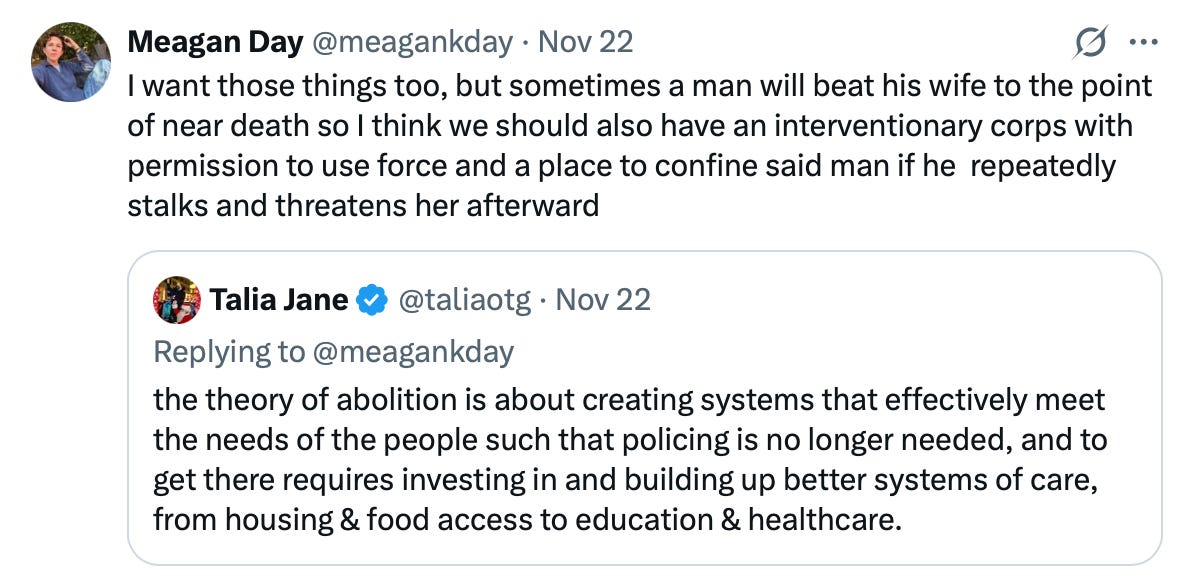
In another exchange, she writes, “I think rape would be vastly more common and endemic today if there were no prison sentences awaiting rapists.”
But perhaps most revealing is her exchange with Nathan Robinson, who expresses his belief that it is possible to create a society where no one needs to be confined in a cage and that he is not that pessimistic about humanity to dismiss this as a possibility.
Day responds:

What really struck me about this, coming from someone who identifies as a socialist, is that Day seems to believe we can fundamentally transform the economic relations that shape our lives but that we can’t transform relations of power and domination between people without relying on punishment and confinement.
And of course, there is something particularly frustrating about using violence against women to justify the existence of police and prisons given the decades of abolitionist feminist scholarship and organizing on this issue. Much of the work of Angela Davis, Beth Richie, Mariame Kaba, Andrea Ritchie, and others is grounded in the experiences of Black women who have faced both interpersonal violence and violence at the hands of the state. For many of these abolitionists, it’s precisely their work confronting violence against women that led them to call for abolition of police and prisons.
Yet Day dismisses abolition as “nonsensical” without any meaningful engagement in this work. Instead, she advocates for what Paul Heideman, also writing in Jacobin, calls “carceral minimalism,” an approach that would involve “prudently reducing the prison population while demanding thorough sentencing reform and improved corrections-officer training.”
This is where I really struggle to understand what this version of socialism envisions for the future. A socialist society with fewer prisons is still a society with prisons. The redistribution of wealth, however extensive, does not in and of itself bring about liberation.
In Taming the Revolution, our book selection this month, Josh Briond describes the existence of an “often unspoken social arrangement” that “manifests through cultural norms that render the mass suffering of groups of people—both at home and abroad—as mundane, even inevitable.” He goes on to explain that within this arrangement, the suffering and premature death of the most marginalized people “are painted as necessary for maintaining the existing social order.” What really bothers me about the version of socialism that Day envisions is how much of this social arrangement would remain intact. Even as she imagines a fundamentally different economic arrangement, the suffering of those subjected to policing and incarceration continues to be accepted as inevitable.
This brings me back to Day’s argument that the left should focus on meeting people’s material needs rather than pursuing demands such as abolition, which she associates with wokeness. This reflects a fundamental misunderstanding of abolitionist politics.
Abolition is a material demand.
The loss of freedom, employment, housing, and income that comes with incarceration is a material deprivation. The economic consequences of separating families through incarceration and family policing can last for generations.
Who exactly does Day imagine the people subjected to policing and incarceration are? Are they not working-class people? Are the families struggling to survive the incarceration of a loved one not working class families?
The conditions that abolitionists seek to transform are not separate from the conditions that socialists ostensibly seek to transform. Yet the idea that the left should prioritize economic demands over abolition reflects an understanding of capitalism in which racial oppression is seen as secondary to economic exploitation rather than foundational to its operation. And Day is not alone in advancing this.
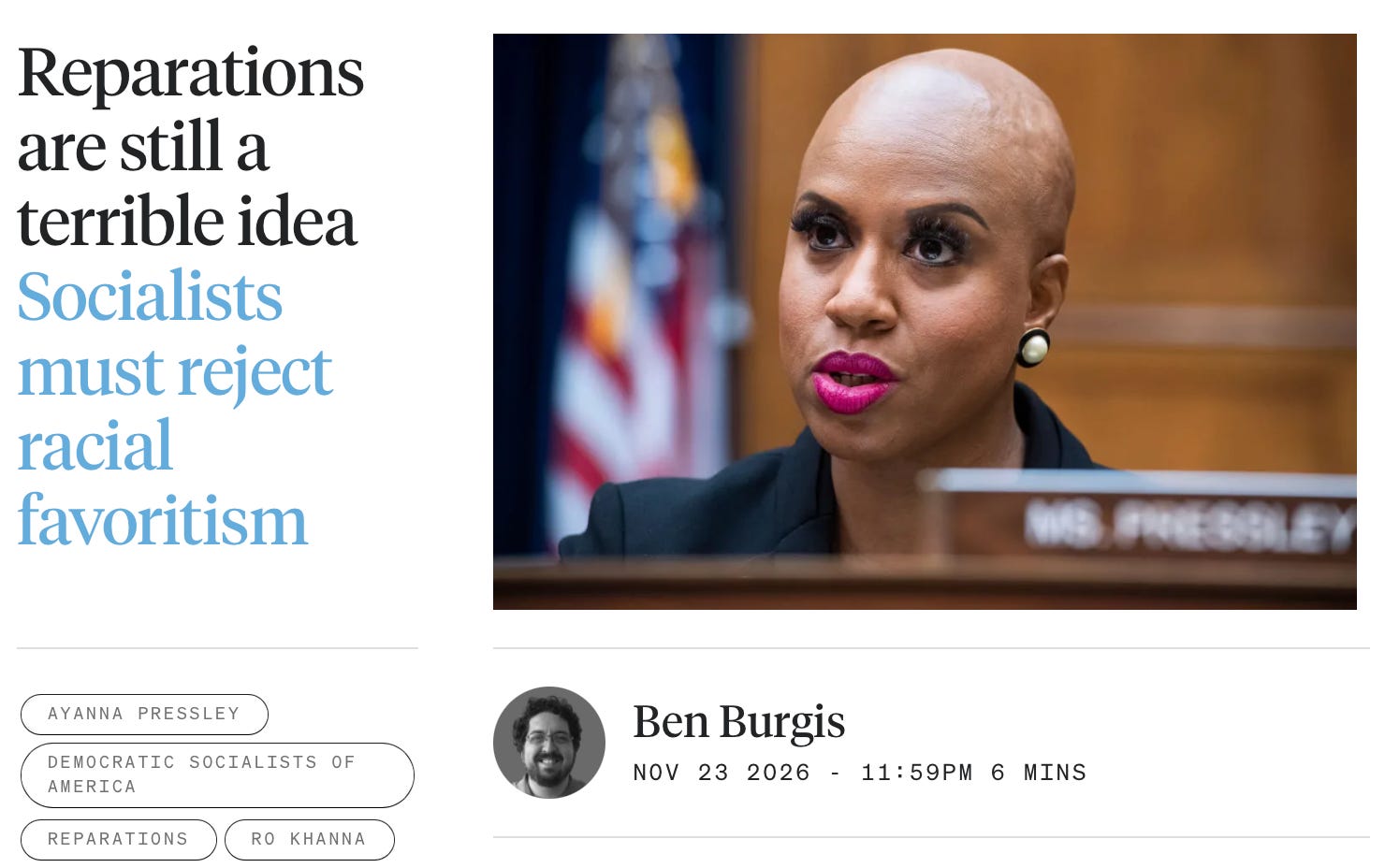
We see a similar line of thinking in Ben Burgis’s article opposing reparations for Black Americans. He argues that reparations are both strategically misguided and inconsistent with socialist principles. In his view, we should not seek any form of wealth distribution that focuses solely on Black Americans because this would “exclude the majority.” Instead, he believes that “principled egalitarians” should be committed to improving the material conditions of everyone, writing, “We should object not to the racially disproportionate distribution of poverty—but to poverty itself.”
But these are not mutually exclusive objections.
Reparations are about repairing the harms that have denied Black Americans the opportunity to accumulate wealth across generations. That obligation doesn’t disappear simply because other people also experience economic deprivation. There is a difference between what everyone is owed simply because they’re human and what is owed to people who have been subjected to horrendous forms of exploitation, dispossession, and violence. A commitment to the former does not absolve our responsibility for the latter.
So I ask again, what is really going on here?
Both articles call for the left to prioritize universalist economic demands while rejecting demands that directly challenge racial oppression. And both suggest that pursuing demands for abolition and reparations will make it harder for the left to build the political support it needs to succeed.
In other words, Black liberation is presented as a political liability.
The issue here goes beyond whether abolition and reparations are achievable. Both authors suggest that these demands should be abandoned because they alienate potential supporters and threaten the success of a socialist movement.
This is a deeply troubling line of thinking. Our commitment to Black liberation cannot be contingent on its perceived usefulness to the electoral success of the left.
There is a difference between a political movement that seeks the liberation of everyone and a political movement that seeks to advance the demands acceptable to the greatest number of people. And when the demands left behind are those that emerge from Black people’s struggles for freedom, we should be very concerned about the political project being advanced in their absence.
In solidarity always,
Alan