

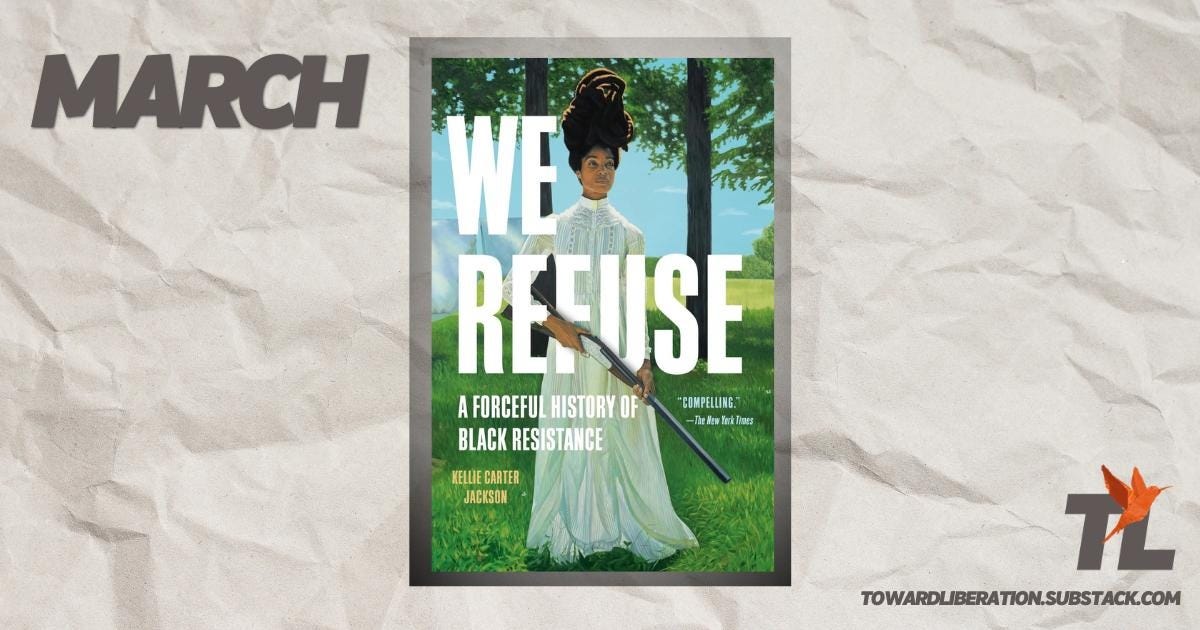
For our March and April reading, we turn to a book that asks us to continue rethinking one of the most policed words in political life—violence.
In We Refuse: A Forceful History of Black Resistance, historian Kellie Carter Jackson revisits the long history of Black resistance in the United States and beyond—not as a simple story of good versus bad tactics, but as a complex, strategic, and deeply human struggle over power. Rather than accepting the narrow scripts we’re often handed about how change “should” happen, she examines the many ways Black communities have confronted white supremacy, especially the leadership and intellectual contributions of Black women whose strategies are often overlooked.
This book feels like a natural next step in the path we’ve been tracing together. After reading Everything for Everyone by M. E. O’Brien and Eman Abdelhadi, which invited us to imagine revolutionary transformation beyond capitalism, and sitting with the insurgent histories explored in Tip of the Spear by Orisanmi Burton, we now turn to a work that interrogates how resistance itself is judged, categorized, and contained.
What counts as legitimate resistance? Who decides which forms of struggle are moral and which are condemned? Why is state and structural violence treated as normal, while the actions of oppressed people are pathologized?
As we continue our theme of revolution, We Refuse pushes us to wrestle with discomfort. If revolution is not a metaphor, then it cannot be reduced to slogans or sanitized narratives. It requires us to think seriously about power, strategy, risk, and ethics.
We’ll spend March and April reading this book together, with prompts and reflections along the way, and then we’ll gather at the end of April to discuss.
I hope you’ll join us as we continue asking harder questions about liberation—and about what refusal makes possible.
What is the date and time for the next online reading group meeting for the book “we refuse”?
Do we know the date of the next Zoom Meet Up?