

I’ll start by admitting that I have only seen Paul Thomas Anderson’s One Battle After Another (OBAA) once. I thought about rewatching the movie to write this but then I considered the first 30 or so minutes of the movie, and decided I couldn’t sit through that again. Much has been said about Teyana Taylor’s character, Perfidia, and Junglepussy’s character, Junglepussy, so I won’t spend a lot of time talking about that. For now I’ll just say that I found both characters to be tragically underdeveloped and lazy caricatures of Black women revolutionaries, especially given some of the inspiration for these characters was the late Assata Shakur, which is just frankly, offensive. If you’re interested in a more detailed analysis of these portrayals, Ellen E. Jones’ piece in The Guardian is thoughtful and worth reading.
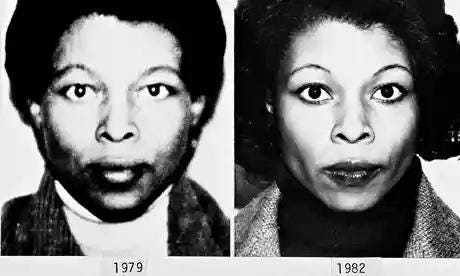
Photo credit: AP
Instead, I want to spend time interrogating what this film (and the public reception of it) reveals about how revolutionary and left politics are understood, flattened, and misrepresented in our current political moment. To say it plainly, this is not a film about revolution. OBAA is a film that uses the aesthetics of revolution to empty it of politics, discipline, and purpose. In doing so, it reinforces the idea that radical movements are incoherent, unserious, and ultimately futile.
We meet the revolutionary group, the French 75, who the movie follows in the opening scenes of the film. They are working on freeing migrants who are imprisoned in an immigrant detention center. At the end of the closing scene, we see migrants being loaded into the truck and are to assume that they have been freed, but we don’t spend enough time on this to really understand what happens to the migrants themselves. In other scenes, we see the French 75 is responsible for blowing up a public official’s campaign office because the official does not support abortion. And, in another especially violent scene, we see the French 75 rob a bank to get money for ammunition. As Junglepussy proclaims during a monologue about what Black power looks like she says, “Your money pays for my artillery.”
These moments suggest guerrilla warfare, but they are never anchored in political strategy, theory, or vision. We are left to assume the French 75 are “left-leaning” or “radical,” but the film does not meaningfully interrogate what they believe, what they are building toward, or how they understand liberation. Violence appears unmoored from politics, as if it exists for its own sake.
The film then fast-forwards to center the remainder of the story on Ghetto Pat, played by Leonardo DiCaprio, and his daughter, Willa, played by Chase Infiniti. Willa is Perfidia’s daughter but her mother has abandoned her. We quickly learn that Willa is under threat of being captured by a white supremacist (who is her biological father), and in an effort to protect her, Pat must reengage the French 75. From here, the film becomes even less about any collective struggle and more about individual redemption and paternal rescue.
I worry about what this film says about revolutionary politics. I think criticism of the left’s effectiveness, especially in this moment, is needed. I do think we have been out-organized and we largely are unsure of what to do in the face of growing authoritarianism and fascism in this country. But, the film doesn’t engage in an instructive critique of leftism, instead it portrays the movies’ revolutionaries as in sum incompetent, lacking any sort of coherent political vision. They also lack principles. Snitching is a core part of the movie; Perfidia snitches on her other French 75 members to save herself. And it’s naive to pretend as though betrayal doesn’t happen in political groups, but these very complex themes require more attention and care than OBAA allows for.
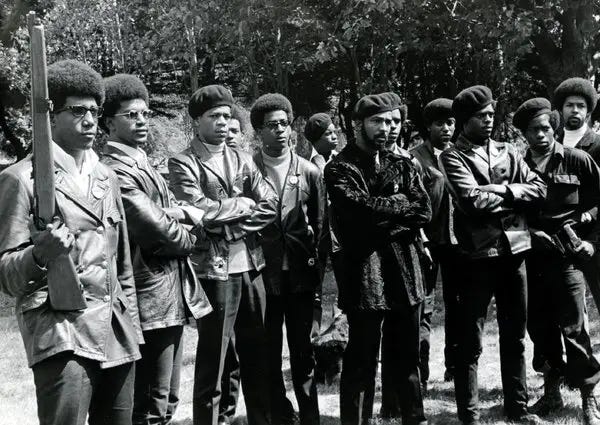
Photo credit: Pirkle Jones and Ruth Marion Baruch
Back to the bank robbery scene: Perfidia shoots a Black security guard at point blank range who is posing little to no threat to them. I am not sure what true Black revolutionary group would shoot a Black man who poses no threat without a thought about the implications or contradictions. And this is part of the issue: we are to understand Perfidia and the French 75 more broadly as a group who do big things but mostly to fuel their own hedonistic desires for a type of nihilistic violence.
I can’t help thinking that this is also what the film makers want us to think about revolutionary politics (and political violence) generally. In another instance, Pat attempts to reengage with the French 75 and calls what is essentially their command center. The person on the other end of the line insists that Pat provide a passcode before sharing sensitive information. Understandably, given the history of COINTELPRO and other state led efforts to dismantle revolutionary groups, the French 75 member who Ghetto Pat speaks with refuses to give Pat the information without a specific passcode. This is good actually, a sign of someone who wants to fiercely protect their organization. But the film portrays the French 75 member as annoying and overly concerned with procedure. I was left understanding that we are supposed to perceive principles, code words, and other safeguards that keep political groups safe from infiltration as annoyingly pedantic.
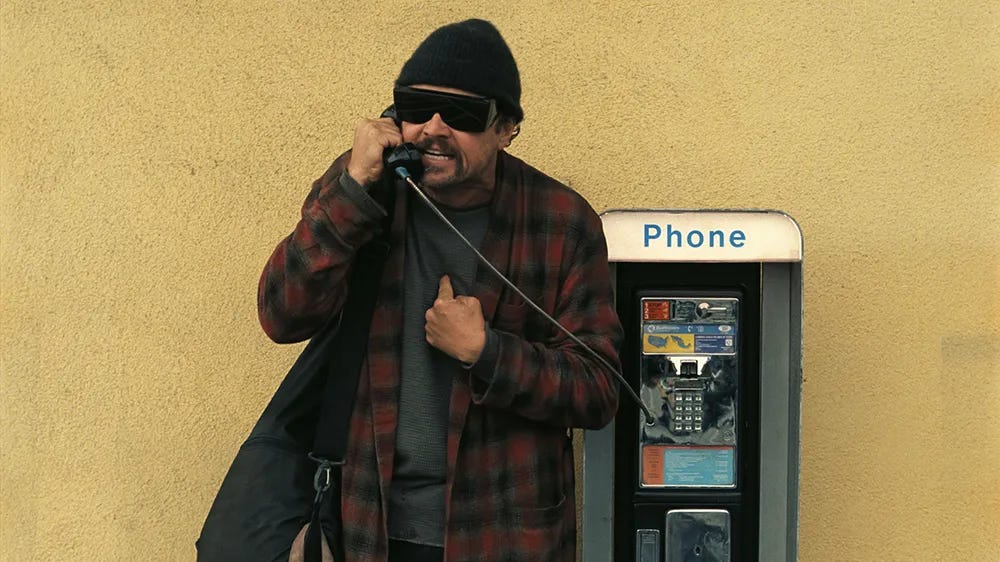
Photo credit: Warner Bros
This is especially dangerous in a political moment like ours. ICE is literally terrorizing communities right now. Keith Porter Jr. was just murdered by an ICE agent in Los Angeles on New Year’s Eve. Renee Nicole Good was also murdered by ICE just last week. ICE agents in Minneapolis are going door to door looking for people who are out of place, enacting racialized terror and surveillance in communities. And, of course, the type of violence we are facing transcends borders as it always does. The Trump administration just abducted Venezuela’s president in an effort to expand U.S. hegemony and the genocide in Palestine continues on.
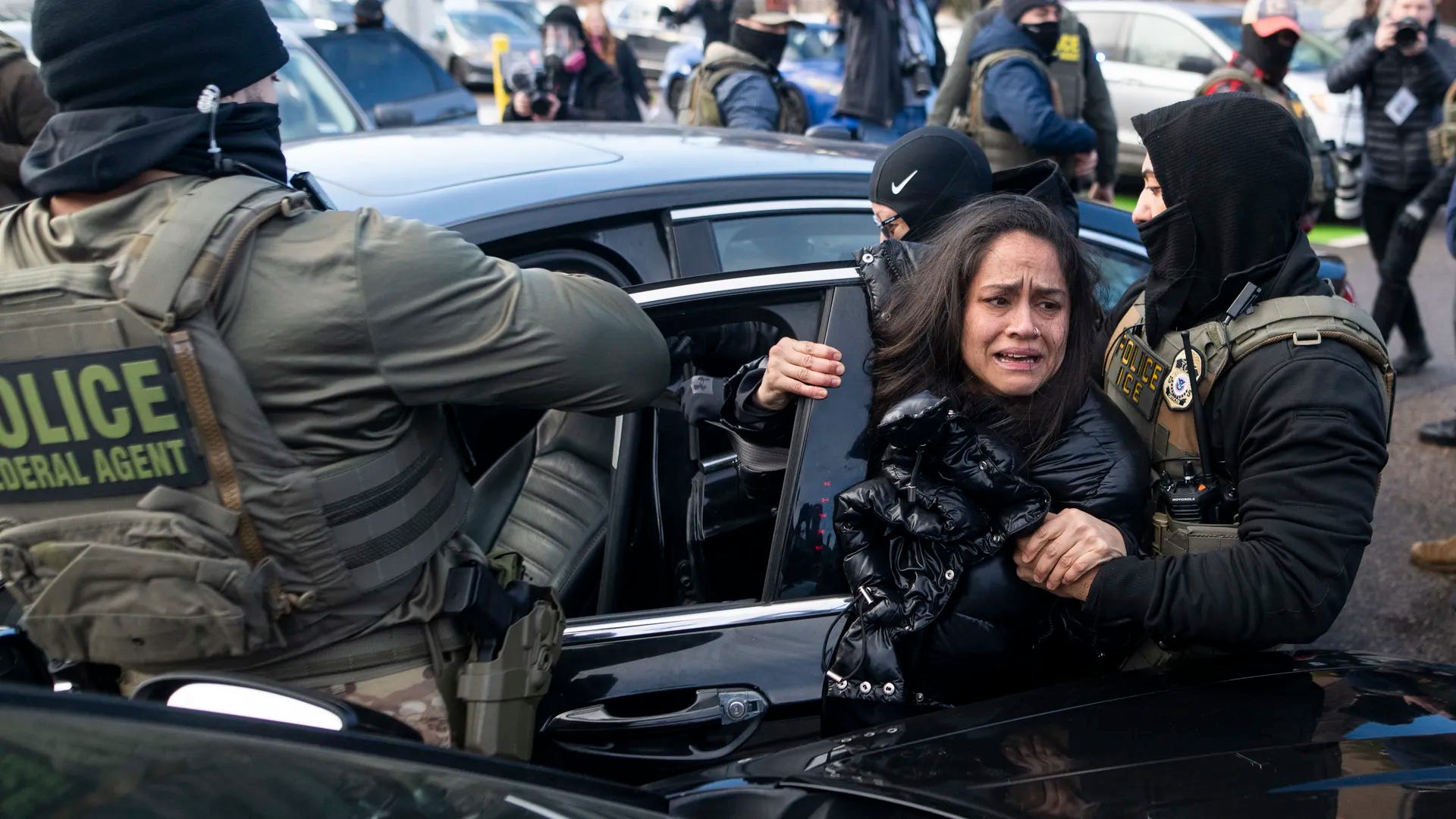
Photo credit: Photo: Stephen Maturen/Getty Images
Yet One Battle After Another offers a version of revolution that is politically empty. In a time like this where we desperately need radical political organizations and actions, it is careless to engage revolution, Black radicals, and guerrilla warfare in this way. Worse, it invites audiences, especially liberal and conservative ones, to punch down on “incompetent” leftists. The film flirts with a shallow “both sides are extreme” logic, creating false equivalence between fascist violence and liberation struggle. In doing so, it is ultimately counter revolutionary. If revolution is incoherent and the right is dangerous, then stability (however violent) becomes the default.
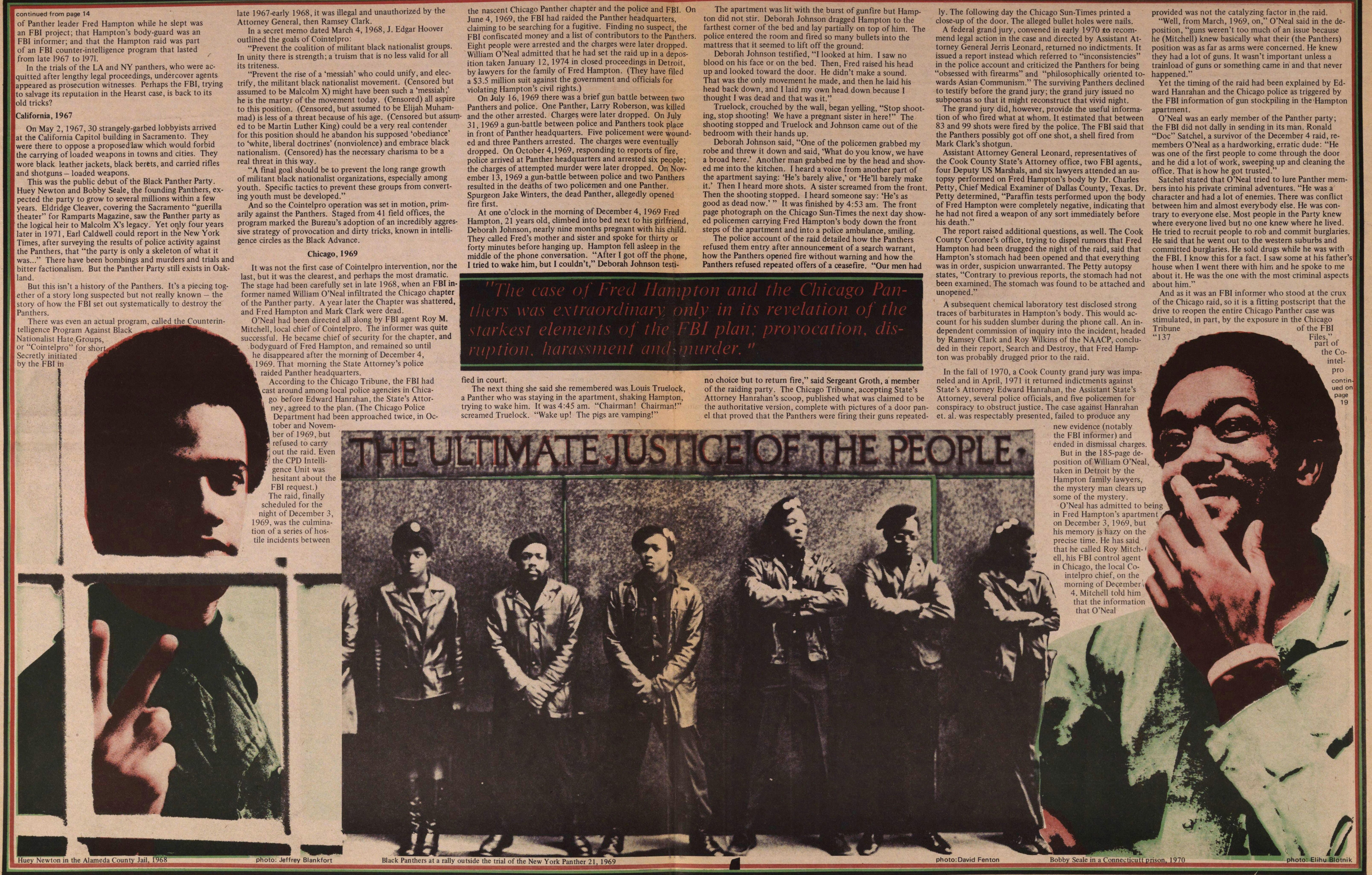
Photo credit: Ann Arbor District Library
The film ends with Pat’s daughter, Willa, leaving the house for a protest. The message here being that Willa is following in her parents’ legacy (I guess). But again we don’t know if she’s part of a political group or even what her politics are. It’s a politically empty ending for a politically empty film. And if anything is true, it’s that we have mistaken going to a one off protest with no platform or demands or voting as the end all be all of our political action.
There’s an argument to be made that we should not look to a Hollywood film to make sense of our current political moment. This is true, but we don’t live our lives in vacuums. So, we should have the tools and political analysis to know when a film is propagandizing us to disengage in sustained, collective political action. I do believe that film, music, literature, and other art forms help us make sense of the world around us. They give texture and voice to feelings we carry but don’t have the words for. They inspire us to build a world worth living in. But art also has the power to narrow our sense of what is possible, to distort what is worth our time, and to make organized political action appear futile, incoherent, or naïve. Liberation will require one battle after another and we will win some and lose many more. In times like these we need art forms that push our collective thinking and capacity for political action forward. We need art that expands our capacity for collective action, not art that trains us to expect its failure.
Toward Liberation is an abolitionist reading group that meets bi-monthly to study radical literature with the goal of moving from theory to praxis. Together, we explore ideas about abolition and liberation, and what it will take to actually get us there. If you want to seriously engage with questions of liberation, join us on February 24th for a discussion of Everything for Everyone: An Oral History of the New York Commune, 2052–2072. The book stretches our political imagination, asking not only what is possible, but what it would take to make it real. Sign up here!
It is also worth saying: I found the film to be entertaining, and it is unarguably beautifully shot. This is not a criticism of the mechanics of its film making. I also recognize that Regina Hall’s character, Deandra, comes to save Willa—a profound action of political commitment. Pat is able to rescue his daughter because Sergio St. Carlos, played by Benicio del Toro, runs what I assume is a highly organized network for migrants. And yet, even here, the film stops short. We are not given insight into why Sergio does this work, what political commitments animate him, or what becomes of the migrants he is supposedly protecting. Are they safe? Is this network part of a broader movement?
"If revolution is incoherent and the right is dangerous, then stability (however violent) becomes the default." I had to read that line several times to fully digest it. It is such a powerful summary.
I’ve been talking with my partner about this! I liked the movie but hated Perfidia’s character for the reasons laid out. I give projects a side eye when the big establishments (ie Golden Globes, Oscars, etc.) affirm them with awards.